Hot Water Heater Not Working: Complete Troubleshooting Checklist
No hot water? Run through this checklist to diagnose the problem before calling a plumber. Covers gas and electric.

May 26, 2026
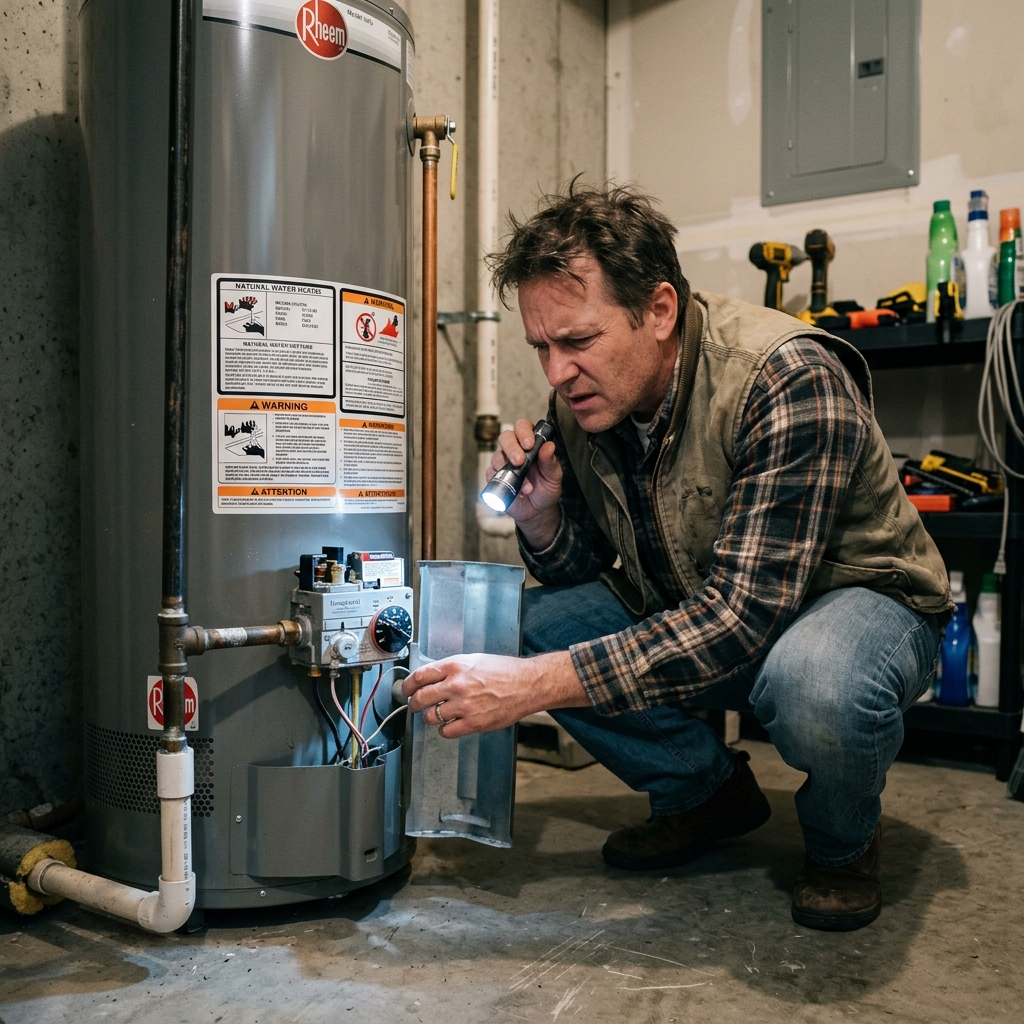
Safety Disclaimer
Water heater maintenance involves working with pressurized systems, scalding hot water, and potentially hazardous electrical or gas connections. Always shut off power (electric heaters) or gas supply (gas heaters) and allow water to cool to a safe temperature before beginning any maintenance. Wear appropriate safety equipment including gloves and eye protection. If you're uncomfortable with any step, contact a licensed plumber.
Unique angle here: a cold tap is a breaker, a reset, a pilot, an element, or a dead tank — work the fuel-specific checklist before you shop a heater. Cold only after a flush is no hot water after flushing. Water on the floor is water heater leaking from bottom.
Desk note: Time and dollar bands below are research ranges from manufacturer labels and typical hardware listings, not a stopwatch or a quote from this desk. This desk does not claim that “half” of no-hot-water calls are DIY. This is a HowToDrainAHotWaterHeater.com Editorial Team research-desk sequence, not a shop diary.
You turn on the hot tap and get cold water. Or lukewarm water. Or water that starts hot and turns cold in three minutes. Whatever the specific symptom, the result is the same: your water heater is not doing its job.
Before you call a plumber, work through this checklist. Many no-hot-water calls are a breaker, a reset, or a pilot — not a new tank. The rest, at least you will know what is wrong before the service tech arrives. Symptom-specific guides (leaks, rust, noise) are listed on the troubleshooting hub.
Before You Reset the Heater
Do this in order. Buying a replacement tank from a cold tap is how people replace a tripped breaker with a $1,500 heater — or dry-fire an electric element after a flush.
- Confirm fuel type. Gas: supply line, control at the base, vent on top. Electric: 240-volt double-pole breaker, access panels, no gas. Wrong path wastes an afternoon. Comparison: electric vs gas.
- Look at the floor and smell the room first. Water at the base is water heater leaking from bottom. Gas odor: leave, call the gas company from outside — water heater safety.
- If you just flushed, stop here. Refill, air lock, dry-fired element, and a pilot left on Off live on no hot water after flushing.
- Electric: breaker, then reset, then meter. Do not keep resetting a breaker that trips immediately. Panel work is skip-DIY. A compact digital multimeter with an ohms range is the meter this site already points at. An element wrench is the thin-wall socket already used on this site if an element is actually open. Full test: how to test a water heater element.
- Gas: viewport, then thermocouple, then stop. A universal thermocouple is the millivolt water-heater lead already used on this site — measure the old length. A tagged water-heater thermocouple search is safer than guessing a furnace igniter ASIN. Pilot that dies when you let go: pilot light will not stay lit.
Listing check (no-hot-water thermocouple, not a furnace igniter): confirm a millivolt water-heater thermocouple whose lead matches the old length — 24-volt furnace hot-surface igniters and 48-inch furnace-only leads share the same “heater not working” search.
Money story: how we make money. Parts bin: water heater maintenance tools.
Quick Diagnostics: Is It Gas or Electric?
The troubleshooting path splits based on your fuel type. Before diving in, confirm what you have:
- Gas water heater: Has a gas line and gas control valve at the bottom. You can see a burner flame or pilot light through the viewport at the base. Has a vent pipe on top.
- Electric water heater: Has no gas connections. Has one or two metal access panels on the front with a thermostat and heating element behind each one. Connected to a 240-volt breaker.
Not sure? Our electric vs. gas comparison covers the differences.
Electric Water Heater: Troubleshooting Checklist
Check 1: Breaker and Power Supply
This is the number one cause of no hot water from an electric heater, and it takes 30 seconds to check.
- Go to your electrical panel.
- Find the breaker labeled “Water Heater” or “WH.” It is typically a 30-amp double-pole breaker.
- Check if it has tripped. A tripped breaker sits in the middle position between On and Off.
- If tripped, flip it fully to Off, then back to On.
- If it trips again immediately, do not keep resetting it. You have a short circuit somewhere and need an electrician.
Check 2: High-Temperature Cutoff (Reset Button)
Electric water heaters have a safety switch called the high-temperature cutoff (also called the reset button or ECO). It trips when the water temperature exceeds 180 degrees F, usually because of a faulty thermostat.
- Turn off the breaker.
- Remove the upper access panel on the front of the heater (usually two screws).
- Pull back the insulation to expose the thermostat.
- Look for a red button. Press it. If you hear a click, the cutoff had tripped.
- Replace the insulation and panel.
- Restore power and wait 60 to 90 minutes for the tank to heat.
If the reset button keeps tripping, the thermostat is likely stuck and sending continuous power to the element. Replace the thermostat.
Check 3: Heating Elements
Electric water heaters have two heating elements: upper and lower. Each one can fail independently, and the symptoms are different:
- Upper element failed: No hot water at all. The upper element heats first; if it is dead, the thermostat never switches to the lower element.
- Lower element failed: Some hot water, but it runs out quickly. The upper element heats the top of the tank, giving you a small volume of hot water before it goes lukewarm.
To test elements, you need a multimeter. Our full guide on how to test water heater elements walks through the process with meter readings and what to look for.
Replacement elements are a research-range $8 to $20 each. Use an element wrench to remove the old one. Those dollars are listing snapshots, not a quote.
Check 4: Thermostat Settings
Someone may have bumped the thermostat dial, or it may have shifted during a power surge. Both thermostats (upper and lower) should be set to 120 degrees F.
- Turn off the breaker.
- Remove both access panels.
- Check both thermostat dials. Adjust to 120 degrees using a flathead screwdriver.
- Replace panels and restore power.
For a deep dive, see our thermostat adjustment guide.
Check 5: Wiring Connections
Loose or corroded wiring at the thermostat or element terminals can interrupt power. With the breaker off, inspect the wire connections at both thermostats and both elements. Tighten any loose screws. Look for burn marks or melted insulation, which indicate a short.
Gas Water Heater: Troubleshooting Checklist
Check 1: Pilot Light
The pilot light is the small flame that ignites the main burner. Look through the viewport at the base of the heater. If you do not see a flame, the pilot is out.
Relight it following the instructions on the heater’s label. The basic steps:
- Turn the gas control to “Off.” Wait 5 minutes.
- Turn to “Pilot.”
- Press and hold the pilot button.
- Click the igniter (or use a long match).
- Hold the button for 60 seconds after the pilot lights, then release slowly.
If the pilot will not stay lit, you have a thermocouple issue. See our pilot light troubleshooting guide for the full diagnostic.
Check 2: Gas Supply
Confirm that gas is reaching the water heater:
- Check the gas shutoff valve on the supply line to the heater. It should be parallel to the pipe (open position).
- Check other gas appliances in the house. If they are also not working, the issue is at the meter or main supply, not the water heater.
- If you recently had utility work done, the gas company may have shut off service and not restored it.
Check 3: Thermocouple
The thermocouple is a safety sensor that sits in the pilot flame. If it is dirty, misaligned, or failed, it shuts off gas flow even though the pilot is lit.
- Clean the tip with fine sandpaper
- Bend it so the tip sits directly in the pilot flame
- If it still fails, replace it with a universal thermocouple (research-range $12 to $20)
Check 4: Gas Control Valve
The gas control valve is the brain of a gas water heater. It controls the pilot, thermostat, and main burner gas supply. If the valve has failed:
- The pilot may light but the main burner never fires
- The status light on the valve may flash an error code (check the label on the heater for code meanings)
- You may hear clicking from the valve as it tries and fails to operate
Gas valve replacement is a research-range $200 to $400 and should be done by a professional. On units over about 8 years old, consider whether replacement makes more sense than repair.
Check 5: Sediment Buildup
If your gas water heater fires but the water is not getting as hot as it should, sediment is a likely culprit. A thick sediment layer at the bottom of the tank insulates the water from the burner flame. The burner runs longer, but the heat is not reaching the water effectively.
Signs of sediment problems:
- Popping or rumbling sounds when the burner fires
- Longer recovery times
- Water that reaches 100 to 110 degrees but cannot hit the set temperature
Flush the tank to clear the sediment. If the noise persists after flushing, the sediment has hardened and the tank is nearing end of life.
Both Types: Common Issues
Broken Dip Tube
The dip tube is a plastic pipe inside the tank that directs incoming cold water to the bottom. If it cracks or breaks, cold water mixes with hot water at the top of the tank, and you get lukewarm water from every faucet.
Signs: Small plastic fragments appearing in faucet screens or showerheads. Water that feels lukewarm regardless of thermostat setting.
Fix: Replace the dip tube. It is accessible through the cold water inlet on top. A replacement tube is a research-range $5 to $10.
High Demand Exceeding Capacity
If you recently added a bathroom, installed a soaking tub, or have houseguests using more hot water than usual, the heater may simply be undersized for the demand.
Signs: Hot water works fine for the first user but runs out progressively faster throughout the day.
Fix: Stagger hot water usage, lower the thermostat on the washing machine to cold, or consider upgrading to a larger tank or tankless system.
Old Age
Water heaters that are past their expected lifespan (8 to 12 years for tank, 15 to 20 for tankless) tend to develop multiple simultaneous issues. If you are chasing one problem after another, the unit is telling you it is time for a replacement. Our guide on how long water heaters last can help you assess where your unit stands.
Diagnostic Summary Table
| Symptom | Most Likely Cause (Electric) | Most Likely Cause (Gas) |
|---|---|---|
| No hot water at all | Tripped breaker, failed upper element | Pilot out, failed thermocouple |
| Some hot water, runs out fast | Failed lower element | Sediment buildup, broken dip tube |
| Water is lukewarm only | Both elements weak, thermostat set low | Thermostat set low, sediment |
| Water too hot | Stuck thermostat, ECO not tripping | Gas valve thermostat stuck open |
| Hot water smells bad | Depleted anode rod | Depleted anode rod |
| Heater makes noise | Scale on elements | Sediment under burner |
Skip the Reset, Call a Plumber
- You smell gas — leave, call the gas company from outside
- The breaker keeps tripping (that is a short, not another reset)
- You cannot isolate an electric tank at the breaker, or you are not comfortable with 240-volt panel and element work
- The gas control valve has failed or the status light is flashing a code you cannot clear
- Water is coming from the steel shell or under the foam
- A fitting is seized and will not turn without loading the tank weld
Do the breaker, reset-button, pilot-relight, thermocouple, thermostat-dial, and flush checks yourself if the tank is isolated and the room does not smell like gas. Popping while it heats: water heater making popping noises. DIY-versus-call: water heater repair: DIY vs. plumber.
Related Guides
- Water Heater Leaking from Bottom
- Water Heater Making Popping Noises
- No Hot Water After Flushing
- Water Heater Safety Guide
- How to Test a Water Heater Element
- Water Heater Pilot Light Won’t Stay Lit
- How to Flush Hub
- Water Heater Maintenance Tools
- Water Heater Troubleshooting
- How We Make Money
Sources
- Rheem Troubleshooting Guide, Manufacturer diagnostic flowcharts
- A.O. Smith Owner’s Manual, Error codes and repair procedures
- U.S. Department of Energy, Water Heating, Efficiency and maintenance recommendations
Editorial Team
Nobody should pay a plumber $300 to turn a drain valve. Our guides are built from manufacturer documentation, plumbing code references, and the documented experience of homeowners and plumbers.