Tank vs. Tankless Water Heaters: Which One Is Right for Your Home?
A detailed comparison of storage tank and tankless water heaters covering cost, efficiency, lifespan, and installation.

May 10, 2026
Safety Disclaimer
Water heater maintenance involves working with pressurized systems, scalding hot water, and potentially hazardous electrical or gas connections. Always shut off power (electric heaters) or gas supply (gas heaters) and allow water to cool to a safe temperature before beginning any maintenance. Wear appropriate safety equipment including gloves and eye protection. If you're uncomfortable with any step, contact a licensed plumber.
Unique angle here: household-fit decision, not a feature dump. The cons-first assessment is Tankless Water Heater Pros and Cons.
Desk note: Cost and lifespan bands below are research ranges from typical listings and published DOE tankless-efficiency language, not a payback calculator from this desk. “Endless hot water” is a flow-rate claim at a stated temperature rise. It is not a promise that two 2.5 GPM rain showers will run in a 40°F groundwater climate on a mid-size electric tankless.
Pick the machine that matches simultaneous fixtures and how long you will stay in the house. Fuel after that is electric vs. gas. Gallon math for a tank is the sizing guide.
Before You Shop Tank vs Tankless
Do this in order. Converting “we have a 50” into a tankless SKU by gallons is the usual miss.
- Count simultaneous fixtures, not people. Two showers plus a dishwasher is a GPM problem for tankless and a first-hour problem for a tank. Write the fixtures and their labeled GPM.
- Measure incoming cold-water temperature in winter. A Taylor instant-read waterproof thermometer in a glass at the nearest cold tap, after a 30-second run, is enough. Heating 40°F groundwater to 120°F is an 80°F rise. The same unit publishes a higher GPM on a 50°F rise.
- Read the current rating plate. Fuel, vent, voltage, and gas-line size tell you whether a tankless swap is a hang-on-the-wall or a gas-line-and-vent project.
- Decide how many years you will stay. Upfront tankless install research ranges are the large number. Energy.gov savings language is the small annual number. A three-year stay rarely “pays back” a gas-line upgrade.
- Then open a listing. Indoor vs outdoor and natural-gas vs propane suffixes sit on the same parent page as the headline GPM.
Listing check (tank vs tankless GPM): confirm gallons-per-minute at a stated temperature rise plus indoor/outdoor and NG/LP suffixes — headline GPM and RV / point-of-use tankless units share the same brand search.
Current tankless SKUs: best tankless water heaters. Descale gear: best tankless flush kits.
How They Work
Tank Water Heaters
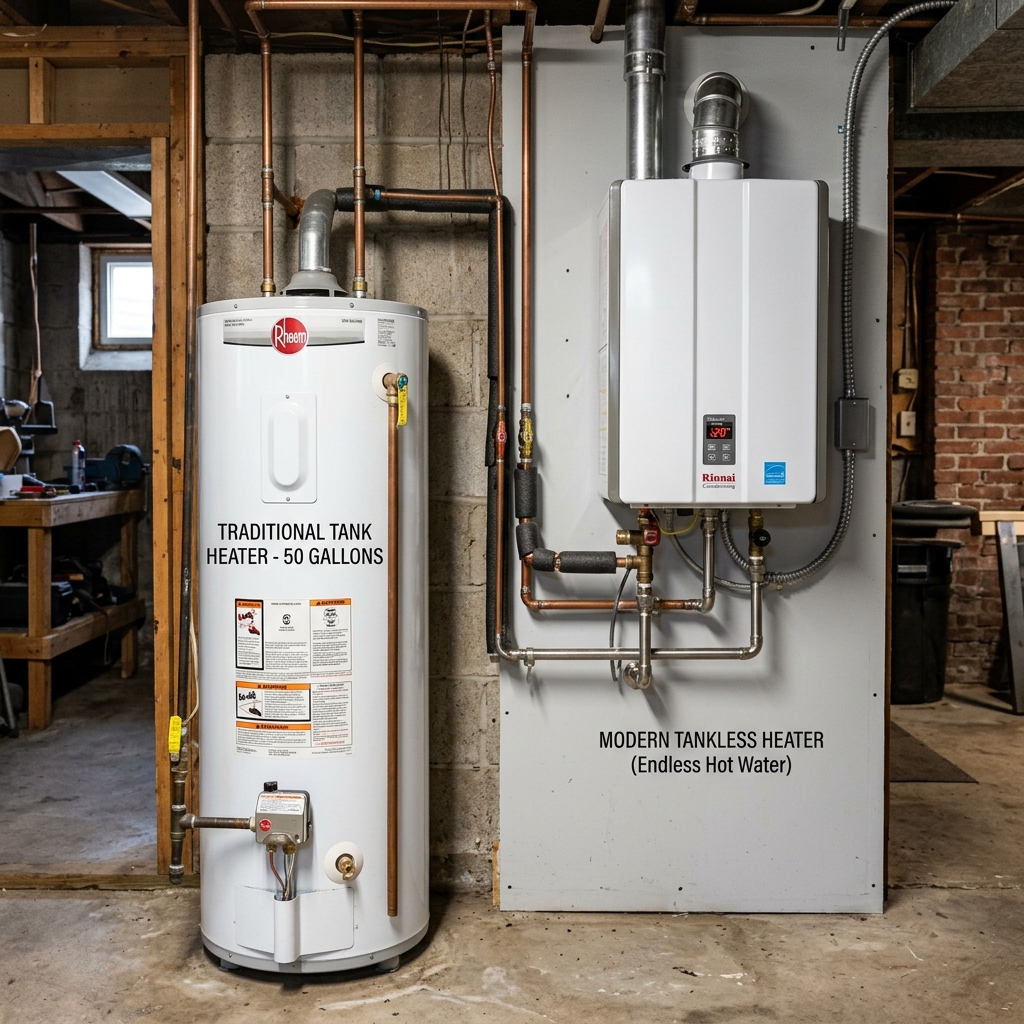
A tank stores 40–80 gallons and keeps that volume hot. Open a tap and preheated water leaves the top while cold water enters the bottom. You can run several fixtures at once until the stored volume and recovery are gone. Standby loss is the price of that buffer. A leaking steel shell is a replacement; a dripping drain valve is a parts job — DIY vs plumber.
Tankless Water Heaters
No storage. Flow through a heat exchanger fires the burner or elements. The unit only runs when a tap is open. Capacity is GPM at your climate’s temperature rise, not gallons on a jacket. Hard-water houses descale the exchanger; they do not “flush the tank.” Compact hose-and-valve tank flushing is a different page: how to flush your water heater.
Cost Comparison (Research Ranges)
| Factor | Tank | Tankless |
|---|---|---|
| Unit cost (research) | $500–$1,500 | $1,000–$3,500 |
| Installation (research) | $300–$800 typical swap | $1,500–$3,000 if vent / gas / panel change |
| Monthly energy (research) | $30–$50 | $15–$30 |
| Published service window | 8–12 years | 15–20 years |
| Annual maintenance (research) | $100–$150 if hired | $150–$300 if hired (descale) |
The Real Math, Without a Payback Promise
A tankless job can land $1,500–$4,500 above a like-for-like tank swap when you add the unit and the gas-line, vent, or panel work. Energy.gov estimates tankless units are about 24–34 percent more energy efficient for households that use 41 gallons or less of hot water a day, and about 8–14 percent for higher-use houses. That is published guidance, not a $200/year guarantee on your bill. If you are selling within a few years, a working tank replacement is usually the cheaper path. If you are staying and you already have the gas and vent capacity, the lifetime-cost story is more plausible.
A hybrid heat-pump tank is the third path if you want electric operating cost closer to tankless without giving up stored volume. See best heat pump water heater 2026. Brand-level reliability: best water heater brands of 2026.
Household-Fit Checks the Feature List Skips
Two showers at once. Add the labeled GPM. Two 2.0 GPM heads are 4 GPM before anyone starts a kitchen tap. A mid-size gas tankless in a cold-groundwater climate may be rated under that on an 80°F rise. A 50-gallon gas tank can still lose the second shower if recovery and stored volume are already spoken for — that is an FHR problem, not a “tankless is endless” problem.
Soaking tub. A 60–80 gallon dump is a storage problem. Tankless can fill a tub only if the GPM at your rise keeps up for the whole fill. Size the tub in gallons and minutes, not in “family of four.”
Hard water. Scale steals tank volume and coats a tankless exchanger. Flushing a tank is the compact hose sequence. Descaling tankless is a pump loop. Hardness number first: how hard water destroys a water heater.
Power outages. A standing-pilot atmospheric gas tank can still heat. Most tankless units and all electric tanks need power. That is a household-fit fact, not a brand talking point.
Pros and Cons (Short)
Tank
- Lower upfront on a same-fuel swap
- Buffer for a tub or a short stacked-shower hour
- Gas atmospheric units can heat without utility power
- Standby loss, floor space, and an 8–12 year published tank window
Tankless
- No stored volume to dump on the floor if a tank would have failed
- Wall space instead of a 50-gallon footprint
- Longer published service window if you descale
- High install adders, cold-water sandwich, and a hard GPM ceiling
Skip the Listing, Call a Plumber
- New gas line, new Category III/IV vent, or a panel upgrade
- A well pump that cannot feed the GPM the tankless chart assumes
- A platform or closet that cannot take the flue, condensate, or combustion-air path
- Any smell of gas, a T&P that dumps steadily, or water from a steel tank shell — repair vs replace before you shop tankless as a lifestyle upgrade
For living with the tank you already have, start at the how to flush hub or the flush schedule calculator.
Related Guides
- Tankless Water Heater Pros and Cons
- Electric vs. Gas Water Heaters
- What Size Water Heater Do You Need?
- Best Tankless Water Heaters
- Best Tankless Water Heater Flush Kits
- How to Flush Your Water Heater: Step-by-Step Guide
- Water Heater Repair: DIY Fixes vs. When to Call a Plumber
- Best Heat Pump Water Heater 2026
- Best Water Heater Brands of 2026
- Water Heater Maintenance Tools
Sources
- U.S. Department of Energy, Tankless or Demand-Type Water Heaters, 24–34% / 8–14% efficiency language by daily use
- Manufacturer temperature-rise GPM charts (Rinnai, Rheem, Navien) for climate sizing
Editorial Team
Nobody should pay a plumber $300 to turn a drain valve. Our guides are built from manufacturer documentation, plumbing code references, and the documented experience of homeowners and plumbers.