How to Back Flush a Water Heater (Break Up Stubborn Sediment)
Learn how to back flush your water heater to remove stubborn sediment that regular draining can't clear. Step-by-step instructions with diagrams.

April 1, 2026
Safety Disclaimer
Water heater maintenance involves working with pressurized systems, scalding hot water, and potentially hazardous electrical or gas connections. Always shut off power (electric heaters) or gas supply (gas heaters) and allow water to cool to a safe temperature before beginning any maintenance. Wear appropriate safety equipment including gloves and eye protection. If you're uncomfortable with any step, contact a licensed plumber.
Regular flushing uses gravity to drain water and sediment out of the tank. It works great for loose, freshly deposited minerals. But if your water heater has gone years without maintenance, or if your water is exceptionally hard, the sediment may have compacted into a dense layer that gravity cannot budge.
Back flushing solves this by reversing the flow. Instead of draining water out through the drain valve, you push pressurized water in through the drain valve. The incoming pressure breaks up compacted sediment and pushes it back into the tank, where you can then stir it up and flush it out the normal way.
This technique is the middle ground between a standard flush and removing the drain valve entirely. It is safe, it uses no special tools beyond what you already have for regular flushing, and it works in most cases where standard draining has failed.
When You Need to Back Flush
You do not need to back flush every time you maintain your water heater. Standard flushing handles routine sediment removal. Back flushing is for specific situations:
- The drain valve is clogged. You open it and nothing comes out, or only a weak trickle flows. The sediment has packed into the valve bore.
- Standard flushing did not stop the popping noises. This means there is a hardened sediment layer on the tank bottom that the regular flush could not dislodge.
- You are flushing a neglected tank for the first time. If the heater has never been flushed, or not in three or more years, the sediment is likely compacted enough to benefit from a back flush.
- The drain water was gritty but stopped flowing. This means sediment mobilized during the flush and then re-clogged the valve.
What You Need
| Item | Purpose |
|---|---|
| Two garden hoses (standard 3/4-inch) | One for the drain valve, one for the supply |
| Access to an outdoor faucet or laundry hookup | Provides pressurized water for the back flush |
| 5-gallon bucket | Catches sediment during forward flushing |
| Channel-lock pliers | Tightens hose connections |
| Work gloves | Protects hands from warm water |
| Towels | Manages drips at connections |
The key requirement is having a way to connect a pressurized water source to the drain valve. An outdoor hose bib is the easiest option. A laundry faucet with a hose adapter also works.
Step-by-Step: How to Back Flush
Step 1: Shut Down the Water Heater
- Turn off the power source. Gas: turn the control valve to “Off” or “Pilot.” Electric: flip the dedicated breaker.
- Close the cold water inlet valve at the top of the heater.
- Wait at least two hours for the water to cool. Back flushing with hot water increases the risk of burns if a connection comes loose.
Warning: Never work on a water heater with the power on. Running a gas burner or electric element while the tank is partially empty can overheat the tank and damage the heating element.
Step 2: Set Up the Back Flush Connection
- Connect a garden hose from the drain valve to a convenient drain point (floor drain, outside, utility sink). This is your forward-flush hose. You will use it later.
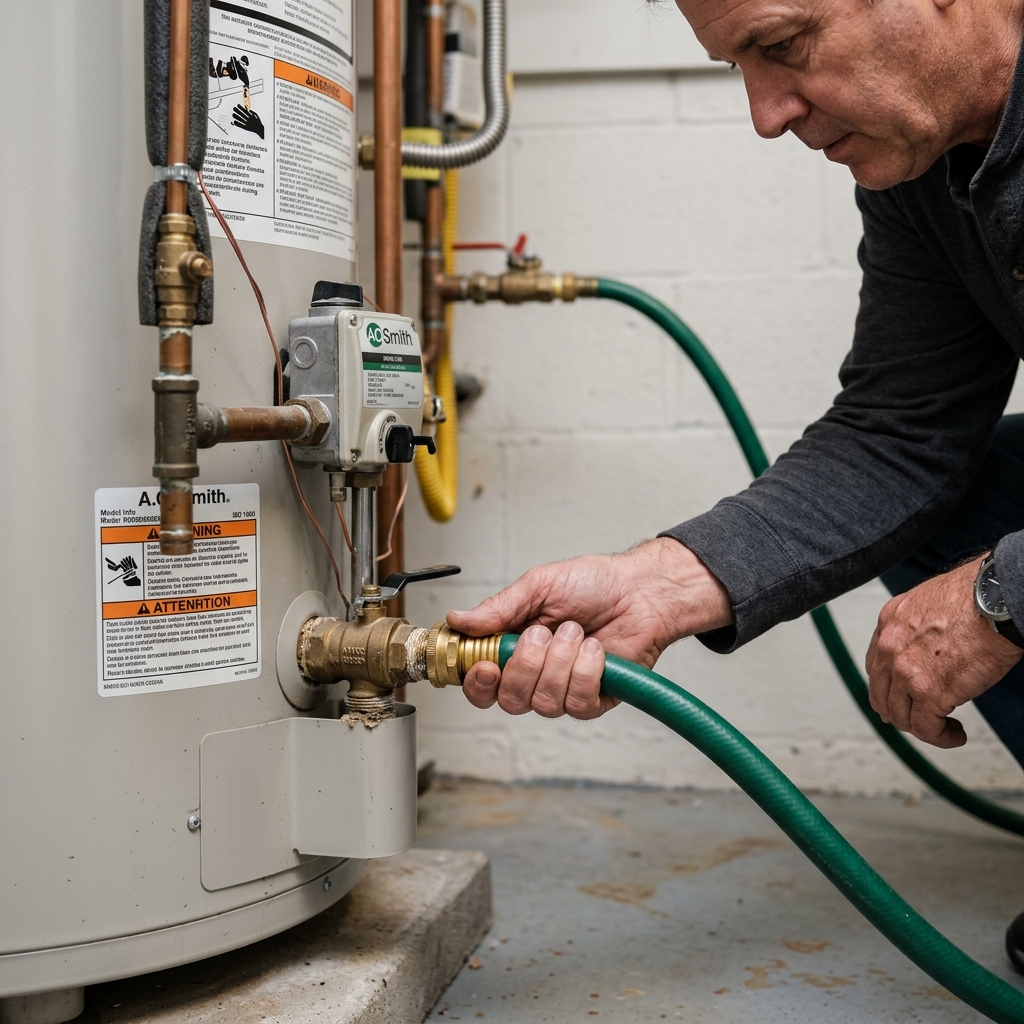
- Connect a second garden hose from an outdoor faucet or laundry hookup to the drain valve. If your drain valve only has one hose connection (most do), you will alternate between the supply hose and the drain hose during the process.
The most practical setup for a single-port drain valve:
- Attach the supply hose to the drain valve.
- Run the back flush (steps below).
- Disconnect the supply hose and attach the drain hose.
- Forward flush to clear the loosened sediment.
- Repeat as needed.
If you have a Y-connector or T-adapter, you can attach both hoses simultaneously and use valves to control flow direction. This is more convenient but not necessary.
Step 3: Run the Back Flush
- Make sure the drain valve on the water heater is closed.
- Open the outdoor faucet (or laundry supply) fully. This sends pressurized water (40-60 PSI) through the hose and into the drain valve in reverse.
- Open the drain valve on the water heater. Water should now flow backward through the valve and into the tank. You will likely hear rushing water inside the tank.
- Let it run for 60 to 90 seconds. The pressurized water pushes against the sediment in the valve and stirs up sediment on the tank bottom.
- Close the outdoor faucet. Then close the water heater drain valve.
Step 4: Forward Flush to Clear Sediment
Now you need to get the loosened sediment out.
- Disconnect the supply hose from the drain valve.
- Connect your drain hose to the drain valve.
- Open the cold water inlet valve at the top of the heater briefly to add water pressure from above.
- Open the drain valve. Water should now flow forward, carrying the sediment you just dislodged out through the hose.
- Let it run until the water clears. This may take five to ten minutes. Watch the water coming out of the hose. It will likely start brown or cloudy and gradually clear up.
Step 5: Repeat If Needed
If the drain flow stops again (meaning sediment re-clogged the valve), repeat Steps 3 and 4. Most tanks clear after two to three cycles of back flush followed by forward flush.
You will know you are done when:
- Water flows freely from the drain valve
- The water coming out is clear or nearly clear
- No more gritty sediment appears in the bucket
Step 6: Refill and Restart
- Close the drain valve firmly.
- Remove the drain hose.
- Open the cold water inlet valve fully to refill the tank.
- Open a hot water faucet in the house and wait until water flows steadily with no air sputtering. This confirms the tank is full.
- Close the faucet.
- Restore power. Gas: turn the control back to your desired setting. Electric: flip the breaker back on.
Important: On electric water heaters, do not turn on the breaker until the tank is completely full. Running the heating elements in an empty or partially empty tank burns them out within minutes. Refer to our guide on how to test a water heater element if you suspect element damage.
What If Back Flushing Does Not Work?
If the sediment is too hardened for water pressure to break through, you have two remaining options:
Remove the Drain Valve
Taking the valve out entirely gives you a larger opening. With the valve removed, you can reach into the tank with a screwdriver or stiff wire to break up calcified deposits manually. This is messy but effective. Our guide on unclogging the drain valve walks through this process.
Vinegar Dissolution
Pouring white vinegar into the tank dissolves calcium carbonate deposits over several hours. This is the best option for the most severe cases where mechanical clearing has failed. You can pour vinegar through the drain opening or through the anode rod port at the top of the tank.
Preventing the Need for Future Back Flushes
Once you have cleared the sediment, the goal is to never let it get that bad again.
Flush on schedule. A standard flush once a year (every six months in hard water areas) prevents sediment from compacting. See our flushing frequency guide for a schedule based on your water hardness.
Upgrade the drain valve. Standard plastic drain valves have a narrow bore that clogs easily. A full-port brass ball valve doubles the opening size, making future flushes faster and clogs far less likely. See our replacement guide.
Address the water hardness. If back flushing was necessary because of heavy mineral content, consider a water softener. Removing calcium and magnesium before they enter the tank is the most effective long-term prevention.
Maintain the anode rod. A functioning anode rod prevents corrosion that adds rust particles to the sediment load. Inspect it every two to three years.
Related Guides
- Water Heater Not Draining?, Complete troubleshooting guide
- How to Unclog a Water Heater Drain Valve, Four methods for clearing blockages
- How to Drain a Hot Water Heater, Standard draining procedure
- How to Flush a Water Heater, Routine flushing walkthrough
Sources
- Family Handyman, Water Heater Maintenance, Flushing techniques
- This Old House, Flush a Water Heater, Maintenance procedures
- U.S. Department of Energy, Water Heating, Sediment and efficiency data
Editorial Team
Nobody should pay a plumber $300 to turn a drain valve. Our guides are built from manufacturer documentation, plumbing code references, and the documented experience of homeowners and plumbers.