Best Tankless Water Heaters
The best tankless water heaters for 2026 compared. Rinnai, Rheem, Navien, and Noritz models rated by flow rate, efficiency, and value.

May 25, 2026
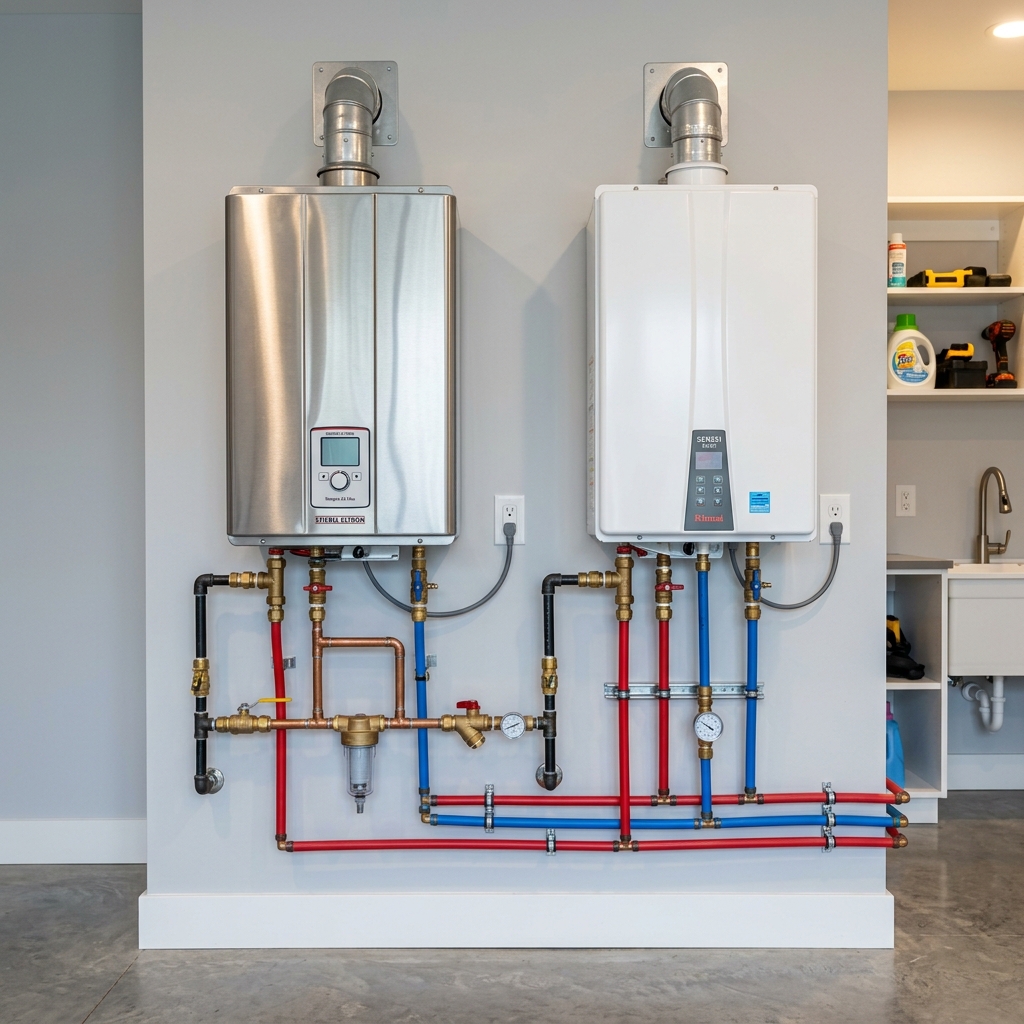
Desk note: Flow rates, UEF figures, and dollar bands below are manufacturer cards, ENERGY STAR rows, and typical listing snapshots — not a lab GPM run from this desk and not live offers. Energy.gov publishes tankless-efficiency language. This page does not invent an unsourced energy-cut percentage or a $200-a-year guarantee. “Endless hot water” is GPM at a stated temperature rise.
The tankless aisle is crowded. Rinnai, Rheem, Navien, Noritz, and a dozen smaller brands all publish a headline GPM. The number that matters is GPM at your winter rise, plus indoor vs outdoor and natural-gas vs propane on the suffix.
Honest cons that kill the sale: tankless water heater pros and cons. Format chooser: tank vs. tankless. Brand-level reliability: best water heater brands of 2026. Heat-pump tank alternative: best heat pump water heater 2026.
Before You Shop a Tankless Unit
Do this in order. Converting “we have a 50” into a tankless SKU by gallons is the usual miss.
- Count simultaneous fixtures, not people. Two showers plus a dishwasher is a GPM problem. Write the fixtures and their labeled GPM.
- Measure incoming cold-water temperature in winter. A Taylor instant-read waterproof thermometer in a glass at the nearest cold tap, after a 30-second run, is enough. Heating 40°F groundwater to 120°F is an 80°F rise. The same unit publishes a higher GPM on a 50°F rise.
- Read the current rating plate. Fuel, vent, voltage, and gas-line size tell you whether this is a hang-on-the-wall or a gas-line-and-vent ticket.
- Decide how many years you will stay. Upfront install research ranges are the large number. Energy.gov savings language is the small annual number.
- Then open a listing. Indoor vs outdoor and natural-gas vs propane suffixes sit on the same parent page as the headline GPM.
Listing check (tankless unit): confirm the SKU matches the indoor/outdoor and natural-gas vs propane suffix before you click Buy — parent search results often mix RU199iN with outdoor or LP variants.
Descale after it is hanging: best tankless flush kits. A tank you are keeping still needs a flush schedule.
What the spec sheet actually means
Flow rate (GPM)
Gallons per minute is the sizing number. Typical fixture draws:
- Shower: 2.0–2.5 GPM
- Kitchen faucet: 1.5 GPM
- Bathroom faucet: 1.0 GPM
- Dishwasher: 1.5 GPM
- Washing machine: 2.0 GPM
Add the fixtures you will run at the same time. That sum is the minimum GPM at your winter rise, not the jacket’s best-case rise.
Uniform Energy Factor (UEF)
UEF replaced Energy Factor. Higher is better. Published gas tankless bands are often 0.87–0.97 UEF. Electric tankless cards often show 0.96–0.99 UEF. That is efficiency of the heat, not proof the install pays back.
Maximum BTU input
For gas, BTU input is how fast the unit can heat. Residential gas tankless commonly lands between 120,000 and 199,000 BTU. Higher BTU helps hold temperature at higher flow.
Minimum activation flow
Most units need about 0.4–0.6 GPM before the burner lights. A single low-flow faucet can sit under that threshold.
Best tankless water heaters for 2026
Street prices move. Treat any dollar band as a research snapshot.
Best overall: Rinnai RU199iN
Contractor-favorite condensing unit. Strong parts and tech support.
Key specs (manufacturer card):
- Max flow rate: 9.8 GPM (at 35°F rise)
- UEF: 0.93
- Max BTU: 199,000
- Minimum activation flow: 0.4 GPM
- Venting: concentric or PVC (condensing)
- Wi-Fi with recirculation option
The 0.4 GPM activation is why it still fires for a low-flow lav. Recirculation compatibility is a separate pump conversation. Families of 3–5: two showers in a moderate-groundwater climate, one shower plus a faucet when incoming water is 40–50°F.
The Rinnai RU199iN is the high-GPM gas listing this site already uses. Confirm indoor vs outdoor and NG vs LP on the suffix.
Best value: Rheem RTGH-95DVLN
Condensing tankless at a lower listing band than Rinnai. Home-center availability. Parts are easy to find.
Key specs (manufacturer card):
- Max flow rate: 9.5 GPM (at 35°F rise)
- UEF: 0.93
- Max BTU: 199,000
- Minimum activation flow: 0.4 GPM
- Venting: concentric PVC (condensing)
- Built-in recirculation pump on this SKU
The built-in pump is the value story. Many competitors add $200–$400 (research range) for recirculation. Families of 2–4.
Best for cold climates: Navien NPE-240A2
199,000 BTU condensing unit. ComfortFlow adds a small internal buffer plus recirculation, which is the usual published answer to the “cold water sandwich.”
Key specs (manufacturer card):
- Max flow rate: 11.2 GPM (at 35°F rise)
- UEF: 0.96
- Max BTU: 199,000
- Minimum activation flow: 0.5 GPM
- Venting: PVC (condensing)
The 0.96 UEF is among the higher published gas numbers. Cold-climate households and 4+ fixture peaks are the fit. The sandwich is a system behavior, not a defect; the buffer hides it.
Best compact: Noritz EZ111-DV
Smaller footprint. Published 8.4 GPM at a 35°F rise. 165,000 BTU. Category III stainless vent.
Key specs (manufacturer card):
- Approx. dimensions: 18.3” W × 27.4” H × 10.3” D
- Minimum activation flow: 0.5 GPM
- UEF: 0.89
Condos, small homes, tight mechanical rooms. Households of 1–3. Two simultaneous fixtures in most mild-rise climates — confirm winter GPM before you commit.
Best electric: Rheem RTEX-18
Practical whole-home electric tankless only in moderate groundwater. 18 kW. Typically two 40-amp breakers. Digital setpoint. Self-modulating power.
Honest limit: electric tankless cannot match gas GPM. The RTEX-18 is a one-shower machine in cold groundwater, maybe two in warm groundwater. Two simultaneous showers means gas, or two electric units and a panel that can take them.
Gas vs. electric tankless (research ranges)
| Factor | Gas tankless | Electric tankless |
|---|---|---|
| Flow rate | 8–11+ GPM (at a mild rise) | 2–5 GPM typical |
| Best for | Whole-home, cold groundwater | Small homes, warm groundwater, point-of-use |
| Install (research) | $1,000–$2,500 | $500–$1,200 |
| Venting | Required (PVC or stainless) | None |
| Electrical | Outlet + sized gas line | 2–3 dedicated 40-amp circuits common |
| Published window | 20+ years | 15–20 years |
For most whole-home, cold-groundwater houses, gas is the technology. Electric is a warm-climate, small-home, or point-of-use path. Fuel-level tank comparison: electric vs. gas. Maintenance after you pick a fuel: gas vs. electric maintenance.
Tank-to-tankless adders
Replacing a tank with a wall unit is not a swap. Common adders (research ranges, not quotes):
- Gas line. Many tanks sit on 1/2-inch. Many tankless units want 3/4-inch. $300–$800 is a common listed band.
- Vent. B-vent usually does not reuse on a condensing unit. PVC or concentric is new. $200–$600.
- Electrical. Gas tankless wants a 120V outlet. Electric tankless wants dedicated 40-amp circuits. $200–$500 per circuit is a common listed band.
- Condensate. Condensing gas units need a drain for acidic condensate. $100–$300 if the drain is not already there.
Annual descale is not optional. Isolation valves plus a flush kit are the hose-and-pump job. Interval: how often to flush (tankless row). A neglected exchanger is an error-code and, later, an exchanger conversation.
Published window: how long water heaters last. Yearly tasks: annual maintenance checklist.
Skip the Tankless Listing
- You need hot water this week and the gas line or vent is not sized
- The panel cannot take the 40-amp pair an electric whole-home unit wants
- You smell gas — that is a plumber and the gas company, not a SKU
- You cannot isolate a leak in a finished living space during a conversion
- You are trying to “solve” hardness by switching machines — that is how hard water destroys a water heater
- The current tank is leaking at the steel shell — replace the machine you can actually hang: DIY vs plumber
Related Guides
- Tankless Water Heater Pros and Cons
- Tank vs. Tankless Water Heaters
- Best Tankless Water Heater Flush Kits
- Best Heat Pump Water Heater 2026
- Best Water Heater Brands of 2026
- Best Water Leak Detectors
- Electric vs. Gas Water Heaters
- How Long Do Water Heaters Last?
- How Often Should You Flush a Water Heater?
- How to Flush a Water Heater
- Water Heater Temperature Settings
- Water Heater Repair: DIY vs. Plumber
- Flush Schedule Calculator
- Water Heater Maintenance Tools
- How to Flush Hub
- How We Make Money
Sources
- U.S. Department of Energy, Tankless or Demand-Type Water Heaters, efficiency language and sizing
- ENERGY STAR, Water Heaters, UEF and certified product lists
- Manufacturer rating plates and install manuals (Rinnai RU199, Rheem RTGH, Navien NPE, Noritz EZ, Rheem RTEX) for GPM-at-rise, vent, and gas-line notes
Editorial Team
Nobody should pay a plumber $300 to turn a drain valve. Our guides are built from manufacturer documentation, plumbing code references, and the documented experience of homeowners and plumbers.