Best Tankless Water Heater Flush Kits (2025)
We researched the top tankless water heater flush kits by pump quality, descaling power, and overall value. Here are the 5 best options for DIY descaling.

February 25, 2025
Desk note: Pump GPH, hose length, and “stronger than vinegar” language below come from manufacturer kit cards (Oatey/Hercules, Eccotemp, Flow-Aide) and the patterns owners and plumbers report after a descale. This is a HowToDrainAHotWaterHeater.com Editorial Team research-desk comparison, not an in-house scale lab. Dollar bands are listing snapshots, not live offers. This page does not invent a percent efficiency recovery after one flush.
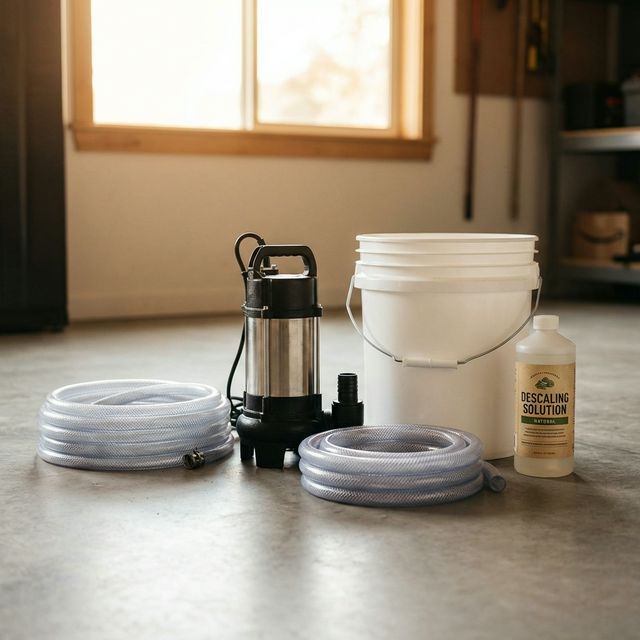
Mineral scale coats a tankless heat exchanger the way lime coats a kettle. Left alone it cuts flow, trips error codes, and is a warranty argument. A flush kit is a pump, hoses that fit the isolation-valve service ports, a bucket, and a descaler. Circulate about an hour, rinse, done.
This is not a tank drain. Tank hose-and-valve steps: how to flush a water heater or the compact how to flush water heater. Current wall-unit SKUs: best tankless water heaters. Honest cons: tankless pros and cons.
Before You Buy a Flush Kit
Do this in order. Buying the bucket first is how people discover the heater was installed without isolation valves.
- Confirm isolation valves exist. Cold inlet and hot outlet should have service ports (usually 3/4-inch hose bibs) with the valves closed for a descale. No ports means a plumber adds them. Do not cut the supply lines to “make a kit work.”
- Read the brand manual for chemistry. Some makers specify white vinegar. Some allow citric. Putting the wrong acid in a published-safe exchanger is a warranty fight.
- Check hardness. A cheap test strip or a utility hardness number is enough. Above about 7 grains / 120 ppm, plan a shorter interval — how often to flush (tankless row).
- Look at hose reach and thread. Most service ports are 3/4-inch garden-hose thread. Tight mechanical rooms want the longer hose kits. Kinked cheap hoses leak at the barb.
- Then open a listing. Parent pages mix a full pump-and-hose kit with a jug of descaler sold alone.
Listing check (flush kit): confirm the kit includes a recirculation pump and isolation-valve hoses, not a jug of descaler sold alone on the same parent listing.
Household-fit before you own a tankless unit: tank vs. tankless. Brand context: best water heater brands of 2026.
What actually matters on the card
| Factor | Why it matters |
|---|---|
| Pump flow | Higher GPH moves solution through the exchanger more thoroughly |
| Descaler | Citric formulas are sold as stronger on mineral scale than household vinegar |
| Hose quality | Cheap hoses kink and weep at the service-port connection |
| Bucket size | 3.5 to 5 gallons holds solution plus splash |
| Thread | Most kits assume 3/4-inch service ports on isolation valves |
The 5 best tankless water heater flush kits
Treat prices as research snapshots. They move.
1. Hercules Haymaker Descaler Kit (top pick)
The Haymaker kit from Oatey/Hercules is the plumber-forum default. Citric formula sold for lime, scale, rust, and sulfates without eating the metals in the exchanger. VOC-free / non-toxic on the card.
Typical kit: 550 GPH recirculation pump, two 5-foot hoses, one quart of Haymaker, 3.5-gallon bucket. The 32 oz bottle is one cycle; buy solution separately next year.
Manufacturer and plumber-forum language commonly calls Haymaker about three times as effective as vinegar on heavy scale. Treat that as published marketing and field talk, not a titration from this desk. Heavy buildup is still the reason to open this listing instead of a vinegar jug.
2. Eccotemp EZ-Flush System Descaler Kit
Pump built into the bucket. 350 GPH. Two 5-foot rubber hoses. Quart of NSF/ANSI 60 descaling concentrate.
Eccotemp EZ-Flush is the compact-storage pick. Everything packs into the bucket. Slower pump than Haymaker. Rubber hoses are the usual wear item.
3. My PlumbingStuff Tankless Flushing Kit (value)
Zoeller-style utility pump, 5-gallon bucket, two 5-foot hoses, quart of Flow-Aide.
My PlumbingStuff kit is the value snapshot: a pump you can reuse for other utility work, and more working volume than a 3.5-gallon pail. Owner reports on hose quality are mixed; braided replacements are a common upgrade.
4. Chromex Tankless Water Heater Flush Kit
1/6 HP pump, 6-foot hoses, bucket, citric descaler.
Chromex kit is the reach pick — the extra foot of hose matters when the isolation valves sit behind a washer. Thinner review history than Hercules or Eccotemp.
5. Kelaro Tankless Water Heater Flushing Kit (budget hardware)
Pump, hoses, and bucket. No descaler in the box. You supply white vinegar or a citric jug.
Kelaro kit is the hardware-only snapshot. Vinegar is enough for light film. Heavy scale still wants a dedicated citric and a pump that actually circulates.
Quick comparison
| Kit | Pump | Descaler in the box | Bucket | Best for |
|---|---|---|---|---|
| Hercules Haymaker | 550 GPH | Yes (citric) | 3.5 gal | Heavy scale |
| Eccotemp EZ-Flush | 350 GPH (built-in) | Yes (NSF) | Integrated | Tight storage |
| My PlumbingStuff | Zoeller-style | Yes (Flow-Aide) | 5 gal | Value / reuse pump |
| Chromex | 1/6 HP | Yes (citric) | Standard | Longer hose reach |
| Kelaro | Standard | No (bring your own) | Standard | Hardware only |
Quick steps (only if isolation valves exist)
- Power the unit off. Close cold-inlet and hot-outlet isolation valves.
- Connect kit hoses to the service ports. Pump suction in the bucket, return to the other port.
- Fill with descaler mixed per the bottle (or vinegar if the brand manual allows it).
- Circulate 45 to 60 minutes.
- Drain. Circulate clean water 5 to 10 minutes.
- Reopen the isolation valves. Restore power. Check for weeps at the ports.
A tank-style hose drain is a different job: how to flush hub. Signs you waited too long: signs your water heater needs flushing. Yearly task list: annual maintenance checklist.
Put a puck near the isolation valves if they weep: best water leak detectors. Hybrid tank instead of a wall unit: best heat pump water heater 2026.
Skip the Kit, Call a Plumber
- Isolation valves were never installed
- You smell gas or see soot at the vent — that is not a descale
- The unit is throwing flow or overheat codes after a correct flush (exchanger or inlet screen beyond a hose job)
- The brand manual forbids the acid you were about to pour
- Hoses will not seal and you would have to force fittings
- You are on a tank, not a tankless — buy a drain hose, not a recirculation bucket: how to flush water heater
Related Guides
- Best Tankless Water Heaters
- Tankless Water Heater Pros and Cons
- Best Heat Pump Water Heater 2026
- Best Water Heater Brands of 2026
- Best Water Leak Detectors
- How to Flush a Water Heater
- How to Flush Your Water Heater
- How Often Should You Flush a Water Heater?
- Signs Your Water Heater Needs Flushing
- How Long Do Water Heaters Last?
- Annual Maintenance Checklist
- How Hard Water Destroys Your Water Heater
- Flush Schedule Calculator
- Water Heater Maintenance Tools
- How to Flush Hub
- How We Make Money
Sources
- Oatey / Hercules Haymaker, descaler chemistry and kit contents
- Eccotemp EZ-Flush, self-contained kit notes
- Manufacturer tankless install manuals (Rinnai, Rheem, Navien, Noritz) for isolation-valve and descale-interval language
- U.S. Department of Energy, Water Heating, maintenance context
Editorial Team
Nobody should pay a plumber $300 to turn a drain valve. Our guides are built from manufacturer documentation, plumbing code references, and the documented experience of homeowners and plumbers.