When to Replace Your Water Heater Anode Rod
Learn how to inspect your water heater's anode rod, spot the warning signs of a depleted rod, and choose between magnesium, aluminum, and powered anode options.

Jake Mitchell
January 4, 2025
Safety Disclaimer
Water heater maintenance involves working with pressurized systems, scalding hot water, and potentially hazardous electrical or gas connections. Always shut off power (electric heaters) or gas supply (gas heaters) and allow water to cool to a safe temperature before beginning any maintenance. Wear appropriate safety equipment including gloves and eye protection. If you're uncomfortable with any step, contact a licensed plumber.
The anode rod is the most important part of your water heater that you’ve probably never thought about. It’s a metal rod, usually magnesium or aluminum, that sits inside the tank and corrodes on purpose. That deliberate corrosion protects the steel tank from rusting. When the rod is used up, the tank itself becomes the target.
Most water heater failures start with a neglected anode rod. Replacing it at the right time is the single best way to extend the life of your water heater by years.
How an Anode Rod Works
Your water heater tank is made of steel lined with a thin layer of glass or porite. That lining protects the steel from direct contact with water, but it’s not perfect. Microscopic cracks, pinholes, and manufacturing imperfections in the lining expose bare steel to the water.
This is where the anode rod comes in. It works through a principle called galvanic corrosion. Magnesium and aluminum are more “reactive” metals than steel. When these metals are submerged in the same water, the more reactive metal corrodes preferentially, sacrificing itself to protect the less reactive one.
The anode rod literally gives itself up so your tank doesn’t have to. That’s why it’s called a “sacrificial” anode.
Over time, the rod dissolves. Once it’s depleted past a certain point, there’s nothing left to sacrifice, and the tank starts corroding.
Signs Your Anode Rod Needs Replacement
You can’t see the anode rod without removing it, but these symptoms strongly suggest it’s depleted:
Rusty or Discolored Hot Water
When the anode rod is gone, the exposed steel inside the tank begins to oxidize. Iron oxide (rust) enters the water supply, giving it a brownish or reddish tint. If only your hot water is discolored and the cold water runs clear, the source is your water heater.
Rotten Egg Smell
A sulfuric, rotten egg odor in your hot water is often linked to the anode rod. Magnesium rods react with sulfate-reducing bacteria naturally present in many water supplies. The reaction produces hydrogen sulfide gas, which causes the distinctive smell.
This doesn’t necessarily mean the rod is depleted. Sometimes a perfectly good magnesium rod produces the smell in water with high sulfate content. Switching to an aluminum-zinc anode often resolves the odor.
Popping or Rumbling Noises
While usually associated with sediment buildup, these noises can also indicate that internal corrosion is accelerating. A failing anode rod contributes to both sediment production and tank deterioration.
Tank Leaking
If you spot water pooling around the base of your water heater, the tank may be corroding from the inside. By this point, replacing the anode rod won’t help. The damage is done, and tank replacement is the next step.
Age of the Water Heater
General rule: if your water heater is three to five years old and you’ve never checked the anode rod, it’s time.
How to Inspect the Anode Rod
You need to remove the rod to inspect it. This takes about 20 minutes.
What You’ll Need
| Tool | Purpose |
|---|---|
| 1-1/16” socket wrench or anode rod socket | Fits the hex head on most rods |
| Breaker bar or long ratchet handle | Provides leverage for stuck rods |
| Teflon tape | Seals the threads on the new rod |
| Garden hose | To drain a few gallons of water |
| Bucket | Catches spilled water |
Steps
- Turn off the power. Electric: breaker off. Gas: pilot setting.
- Close the cold water supply valve.
- Drain 2 to 3 gallons from the drain valve at the bottom. This relieves pressure and prevents overflow when you remove the rod.
- Locate the anode rod. It’s usually on top of the water heater, under a plastic or metal cap. On some models, it’s hidden under the sheet metal top and shares a fitting with the hot water outlet.
- Remove the hex head. Place your socket on the hex head (1-1/16” for most residential heaters) and turn counterclockwise. The rod may be stuck. If so, have someone hold the tank steady while you apply leverage.
- Pull the rod out. It may be three to four feet long, so make sure you have enough clearance above the heater. If ceiling height is limited, look into flexible segmented anode rods as a replacement.
- Inspect it. See the condition chart below.
Condition Chart: Replace or Not?
| Condition | Action |
|---|---|
| Rod is mostly intact with minor surface pitting | Keep it. Check again in 1-2 years. |
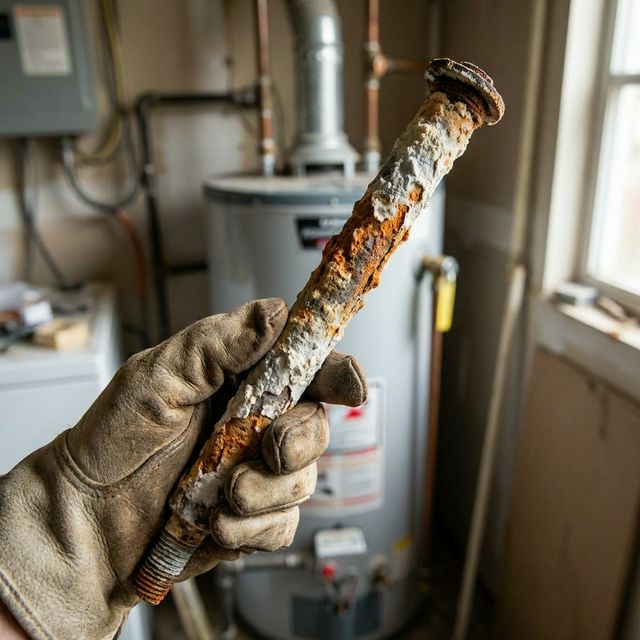
| Rod is 50% or more corroded, visibly thinner | Replace it. It has 6-12 months left at most. |
| Rod is corroded down to the steel core wire | Replace immediately. Your tank is unprotected. |
| Rod is gone entirely (just the wire left) | Replace immediately and inspect the tank for internal corrosion. |
| Rod is intact but coated in calcium deposits | Replace it. Calcium coating prevents the rod from working. |
Magnesium vs. Aluminum vs. Powered Anodes
The anode rod material matters. The right choice depends on your water chemistry.
Magnesium Anode Rods
- Best for: Soft water (under 120 ppm hardness)
- Protection level: Highest. Produces the strongest protective current.
- Lifespan: 3 to 5 years on average, shorter in aggressive water
- Downsides: Can cause rotten egg smell in water with high sulfate content. Corrodes faster, needing more frequent replacement.
Magnesium is the standard choice for most residential water heaters. If your water is relatively soft and you don’t have sulfur issues, stick with magnesium.
Aluminum (and Aluminum-Zinc) Anode Rods
- Best for: Hard water (over 120 ppm) or water with sulfur smell
- Protection level: Good, but lower than magnesium
- Lifespan: 4 to 6 years, longer than magnesium in hard water
- Downsides: Marginally lower corrosion protection. Some concerns (largely debated) about trace aluminum in water.
Aluminum rods last longer because they corrode more slowly. The aluminum-zinc alloy variant is specifically designed to combat the hydrogen sulfide bacteria that cause the rotten egg smell.
Powered (Impressed Current) Anode Rods
- Best for: Anyone who wants a long-term solution
- Protection level: Excellent, adjustable
- Lifespan: 10 to 20+ years (titanium rod doesn’t corrode)
- Downsides: Higher upfront cost ($80-$200 vs. $20-$40 for sacrificial rods). Requires a power outlet near the water heater.
Powered anodes use a small electrical current to provide cathodic protection without sacrificing any metal. The titanium rod doesn’t dissolve, so you never need to replace it. They also eliminate the rotten egg smell completely.
If your water heater is in good condition and you want to protect it for the long haul, a powered anode is worth the investment.
How to Replace the Anode Rod
Once you’ve inspected the old rod and decided it needs replacing:
- Choose the right rod. Match the thread size to your water heater (most residential models use 3/4” NPT). Choose your material based on the guide above.
- Wrap the threads. Apply 4 to 5 wraps of Teflon tape to the threads of the new rod.
- Insert the new rod. Slide it into the port and hand-tighten.
- Torque it. Use your socket wrench to snug the rod down. Don’t overtighten. A firm 1/4 to 1/2 turn past hand-tight is sufficient.
- Refill the tank. Open the cold water supply and bleed air from a hot faucet until the stream is steady.
- Restore power. Turn the breaker or gas valve back on.
- Check for leaks around the anode rod fitting.
Clearance tip: If you don’t have enough headroom above your water heater to install a standard 44-inch rod, a flexible segmented anode rod works in tight spaces. These rods are made of short segments connected by a cable, allowing them to bend as you insert them.
Maintenance Schedule
| Action | Frequency |
|---|---|
| Inspect the anode rod | Every 2-3 years (annually in hard water) |
| Replace sacrificial anode | Every 3-5 years (when 50%+ corroded) |
| Replace powered anode | Every 10-20 years (check manufacturer spec) |
| Flush the tank | Every 6-12 months (helps preserve the anode) |
Frequently Asked Questions
Can I use my water heater without an anode rod?
Technically yes, but the tank will corrode much faster. Most tanks will develop internal rust within one to two years without anode protection, and leaks within three to five years.
How much does an anode rod replacement cost?
A DIY replacement costs $20 to $40 for the rod plus your time. A plumber typically charges $150 to $300 including parts and labor.
Will replacing the anode rod fix rusty water?
If the rust is coming from the anode rod dissolving (normal), a new rod should improve water clarity. If the tank itself is rusting internally, a new rod will slow the corrosion but may not fully eliminate discoloration.
Can I install a magnesium rod in a heater that came with aluminum?
Yes. You can switch between magnesium and aluminum as long as the thread size matches. If you switch to magnesium and notice a rotten egg smell, switch back to aluminum-zinc.
How do I know which anode rod is already in my water heater?
Remove it and check the color. Magnesium rods are silvery-gray. Aluminum rods are lighter in color and may appear whitish. You can also check your owner’s manual or the manufacturer’s website.
Related Guides
- Anode Rod Products & Reviews — Find the right replacement rod
- How to Drain a Hot Water Heater — You’ll drain partial water for rod access
- How to Flush a Water Heater — Combine flushing with rod replacement
- Gas vs. Electric Maintenance — Anode rods work the same in both types
Sources
- Camco — Anode Rod Selection Guide — Rod material comparisons
- A.O. Smith — Anode Rod FAQs — Manufacturer replacement guidelines
- U.S. Department of Energy — Water Heating — Tank longevity recommendations
Jake Mitchell
Lead Writer
Jake covers water heater maintenance and repair for HowToDrainAHotWaterHeater.com. With 30 articles published and hundreds of hours researching manufacturer documentation, plumbing codes, and community forums, he focuses on honest, practical guides built from real user experiences and verified specifications.