Water Heater Anode Rods Explained: The Part That Saves Your Tank
The anode rod is a sacrificial metal bar that prevents your tank from rusting. Replacing it can double your water heater lifespan.

May 10, 2026
Safety Disclaimer
Water heater maintenance involves working with pressurized systems, scalding hot water, and potentially hazardous electrical or gas connections. Always shut off power (electric heaters) or gas supply (gas heaters) and allow water to cool to a safe temperature before beginning any maintenance. Wear appropriate safety equipment including gloves and eye protection. If you're uncomfortable with any step, contact a licensed plumber.
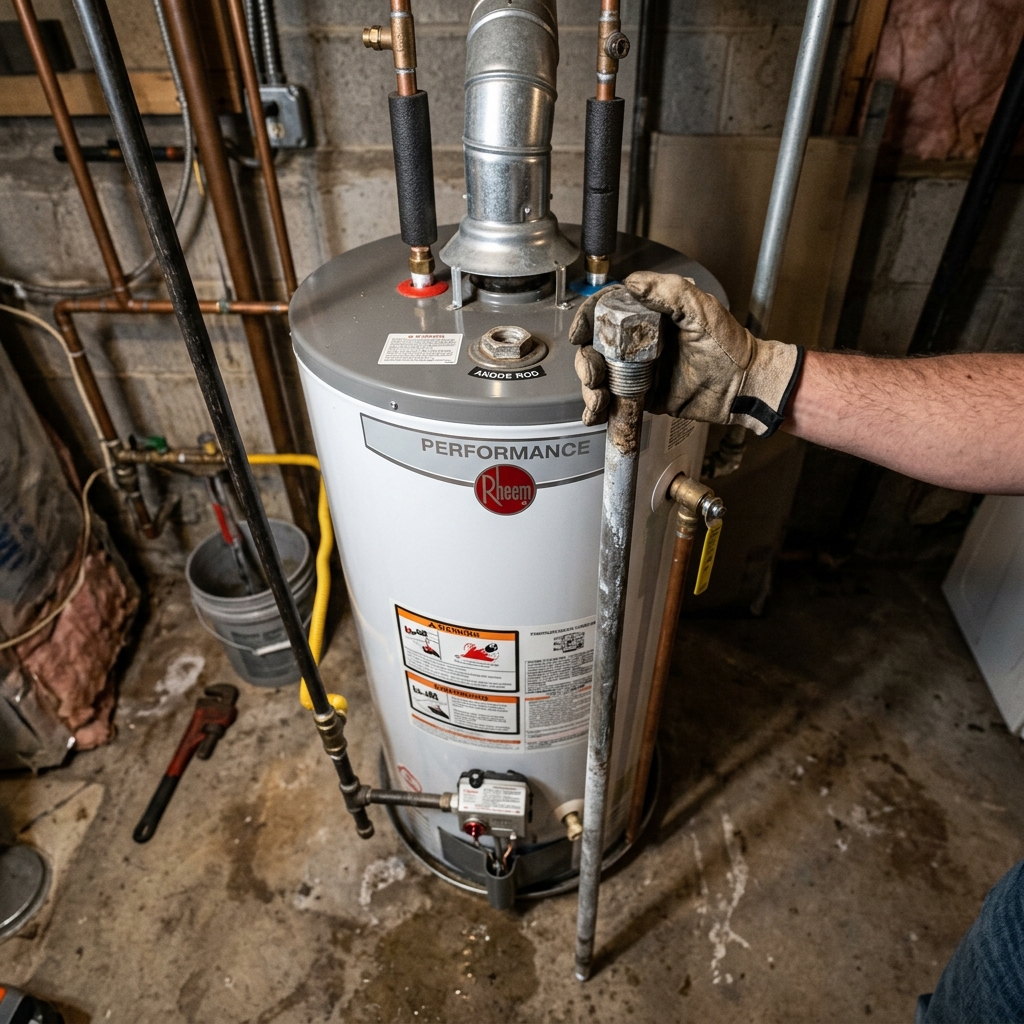
An anode rod is a metal rod (usually magnesium or aluminum) suspended inside your water heater tank from the top. It is designed to corrode instead of your tank. Through a process called galvanic corrosion, the anode rod attracts the corrosive minerals in your water, sacrificing itself to protect the steel tank walls.
This page is the chemistry-and-shopping explainer, not a parts listicle. Amazon search pages mix RV stubs, 3/4-inch residential rods, and powered probes on the same results screen. The unique angle here is water-chemistry first, then clearance and tool sequence, then a go/no-go on whether a new rod can still save the tank. Inspection timing lives in when to replace your anode rod. The hex-and-port walkthrough is anode rod replacement. If the hot taps are already rust-colored, pair this guide with why hot water is brown or rusty so you can tell a spent rod from a tank that is already leaking steel.
Desk note: This is a research-desk explainer from manufacturer FAQs (A.O. Smith, Rheem, Camco) and owner reports, not a staged shop diary and not an in-house corrosion lab. Lifespan and cost ranges below are published or commonly reported figures, not invented benchmarks.
Without an anode rod, manufacturer service literature treats tank rust-through as a short-horizon failure. With a working rod, many residential tanks last in the 8–12 year window. Those are typical published ranges, not a promise for every well or every softener setup.
What Is an Anode Rod?
Your tank is a steel vessel with a thin glass (vitreous enamel) lining. Heating cycles open microscopic cracks in that lining. Water then sees bare steel. The anode is a more reactive metal hung in the same water so it dissolves first. That is galvanic (sacrificial) protection.
The rod is not a filter and it is not a softener. It does not stop sediment. It does not fix a T&P valve that is dripping. It only keeps the steel from becoming the next metal in line.
Most homeowners never look at it. The hex is on top of the tank, often under a plastic cap, sometimes combined with the hot-water outlet. For every anode article on this site, start at the anode rod replacement hub.
Safety Order Before You Shop or Wrench
Do this in order. Buying a rod first is how people end up with an RV-length magnesium stub for a 50-gallon closet install.
- Power or gas off. Electric: breaker off, then verify at the tank. Gas: control to Pilot or Off. Never open the tank while an electric element can dry-fire.
- Decide whether the tank is already finished. Water on the floor from the steel shell is a replacement job, not a rod job. See water heater leaking from the bottom.
- Drop a few gallons. Close the cold inlet, open a hot faucet to break vacuum, and drain enough through the drain guide that the port will not fountain when the hex comes out.
- Confirm the port and the clearance. Dedicated 3/4-inch NPT anode port vs a combo hot-outlet anode. Ceiling height vs a rigid 42–44 inch rod. Tight closets need a segmented rod, not a longer Amazon listing.
- Then choose the metal. Soft municipal water, hard water, well sulfur, and a powered probe are different SKUs.
If you are on a well and the complaint is smell plus color, read the rusty-water glass test before you order. A new magnesium rod can make a sulfate well smell worse.
Types of Anode Rods
Magnesium Anode Rods (Most Common)
- Standard in most new water heaters
- Best for homes with soft to moderately hard municipal water
- Corrodes faster in hard water or well water with high sulfate content
- Can produce hydrogen sulfide (rotten egg smell) in some water chemistries
A typical hardware-store magnesium rod is a 3/4-inch NPT, roughly 42-inch bar. Street prices commonly land in the $20–$40 research range; treat listing prices as current, not a quote. The Camco magnesium anode rod is the residential length most 40–50 gallon tanks expect, not an RV stub.
For more on this topic, see our guide on When to Replace Your Water Heater Anode Rod.
Aluminum/Zinc Anode Rods
- Better for hard water and well water
- The zinc component helps reduce sulfur smell
- Corrodes more slowly than magnesium
- Some health concerns about aluminum leaching (minimal at water heater temperatures)
Use aluminum-zinc when a magnesium rod already produced a sulfur smell, or when the last rod vanished in two or three years in aggressive water. Do not treat aluminum as “the upgrade” for every house. Magnesium still gives the stronger sacrificial current in mild water.
Powered (Impressed Current) Anode Rods
- Uses electrical current instead of sacrificial metal to prevent corrosion
- The titanium probe does not dissolve the way a magnesium bar does
- Eliminates the magnesium-plus-sulfate rotten egg reaction in most owner reports
- Typical listing range is about $90–$200 one-time, plus a nearby outlet; that is a research range, not a quote
Powered rods still require you to remove the old sacrificial rod. They do not skip the seized-hex problem. Compare listings in best powered anode rods. A common 40–89 gallon residential probe is the Corro-Protec powered anode. Confirm a dedicated top port, not a hot-outlet combo fitting.
Listing check (anode explainer): match thread (usually 3/4-inch NPT), rod length to tank height, and dedicated anode port vs combo hot-outlet before you click a 42-inch residential listing that sits next to RV and point-of-use stubs.
Household Reality: Closets, Wells, and Winter Hoses
These are the conditions generic shopping pages skip.
Low ceiling or platform install. A rigid 42-inch rod will not come out in one piece. A 44-inch flexible segmented anode kit bends through a short closet. Confirm 3/4-inch NPT and that your brand does not use a Bradford White-style different port.
Well water with sulfur or iron. Smell is not the same complaint as rust color. Magnesium plus sulfate-reducing bacteria makes hydrogen sulfide. Iron in the well can tint hot water even with a healthy rod. The glass test in brown or rusty hot water comes first.
Unheated garage or utility closet in winter. If you drain to an outdoor hose, a charged garden hose can freeze in the yard. Drain to a utility sink, a floor drain, or wait for a thaw. The flush schedule calculator is for cadence, not for dumping scalding water onto ice.
Softener in the house. Softened water can eat a magnesium rod faster. Check more often. That is a manufacturer-maintenance pattern, not a lab result from this desk.
When to Replace
Check your anode rod every 2-3 years. Replace it when:
- The rod is less than 1/2 inch in diameter (original diameter is typically 3/4 inch)
- The rod is coated in calcium deposits
- The steel wire core is visible through the corroded metal
- You notice rust-colored water or a rotten egg smell
A rod that is half gone is still working. A rod that is a rusty wire is late. Color in the hot taps is a late symptom; by then you also need the rusty-water diagnosis, not only a new bar.
The full walkthrough with clearance tricks and socket size is in anode rod replacement.
Tool Sequence (Not a Random Cart)
- 1-1/16 inch six-point socket and a breaker bar. Twelve-point sockets round the hex. A 1-1/16 inch anode socket on a 1/2-inch drive is the usual residential fit; confirm the hex on your plug before you buy.
- A second person or a strap so the tank does not spin on its piping.
- Hose and bucket so you can drop a few gallons and watch the first quart. If that quart is full of rust flakes, stop treating this as a $25 Saturday part.
- PTFE tape for the new threads. Hand-start, then snug. Do not crush the fitting.
- Only then the replacement rod that matched chemistry and clearance.
If the drain valve will not pass water, clear it first: how to unclog a water heater drain valve. Do not snap a plastic stem to “just get the rod out.”
How to Check and Replace (DIY)
- Turn off the water heater and cold water supply.
- Locate the hex head on top of the heater (the anode rod port).
- Use a 1-1/16 inch socket and breaker bar to loosen the rod. This may require significant force.
- Pull the rod straight up and out of the tank.
- Inspect the condition. If heavily corroded, install a new rod.
- Apply Teflon tape to the threads of the new rod and thread it into the port.
- Restore water and power. Open a hot faucet until the stream is steady before you restore an electric breaker.
When to Skip DIY
Call a licensed plumber, or stop and replace the tank, when:
- The tank is leaking from the steel shell
- The hex will not break and the tank starts to twist
- The anode is combined with the hot outlet and you are not set up to remake that joint
- You smell gas while working on a gas heater (leave and call the gas company; relighting a pilot that will not stay lit is a different job)
- The heater sits over a finished ceiling and a mistake floods living space
- You are not comfortable cutting power, draining, or working over a full tank of hot water
A new rod will not reseal a rusted tank and it will not stop a T&P valve that is opening because pressure or temperature is high. Those are different parts.
Related Guides
Editorial Team
Nobody should pay a plumber $300 to turn a drain valve. Our guides are built from manufacturer documentation, plumbing code references, and the documented experience of homeowners and plumbers.