Best Water Leak Detectors for Water Heaters (2025)
We researched WiFi-enabled and basic water leak detectors to protect your home from water heater leaks. Here are the 5 best options for early leak detection.

February 25, 2025
Desk note: Detection speed, battery-life claims, and hub vs Wi-Fi notes below come from manufacturer cards and editorial reviews (not an in-house flood lab). This is a HowToDrainAHotWaterHeater.com Editorial Team research-desk comparison. Dollar bands are listing snapshots, not live offers. Insurer write-ups put many water-damage claims in the thousands; this page does not invent a single national average as a desk statistic.
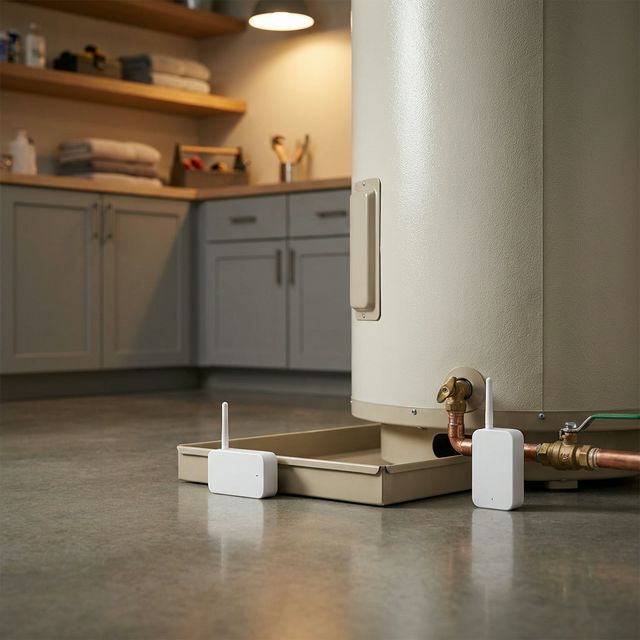
A tank that weeps unnoticed can empty onto a floor. A $15–$40 (research range) puck in the pan catches the first drip. A whole-house shutoff valve is a different job.
This site already uses the Govee WiFi water leak detector three-pack on other keepers as the hub-plus-puck set. Compare it here against a premium sensor, a cable sensor, a long-battery hub kit, and a simple direct-Wi-Fi puck.
If the water is already on the floor, diagnose before you shop sensors: water heater leaking from the bottom and signs a water heater is failing. Brand and format if the tank is done: best water heater brands of 2026.
Before You Buy a Leak Detector
Do this in order. Buying a shutoff kit first is how people order a plumber valve when they needed a $20 puck.
- Decide alert vs shutoff. A puck beeps and (on Wi-Fi models) texts you. An automatic main shutoff is inline plumbing. If you cannot isolate the house, skip the valve kit.
- Check the radio. Most of these sensors want 2.4 GHz Wi-Fi. A 5 GHz-only guest network will not see them. Hub kits need an outlet for the hub.
- Look at the pan. A Camco drain pan gives the first drip a place to pool. Put the sensor in the pan, not on a dry shelf.
- Count wet spots. Tank jacket, T&P discharge, supply unions, and the floor drain are four different puddles. A 3-pack is the usual coverage, not one puck in the hallway.
- Then open a listing. Parent pages mix a hub-plus-sensor pack with a beep-only puck and a whole-house valve.
Listing check (leak detector): confirm you are opening the Wi-Fi hub plus sensor pack, not a standalone beep-only puck bundled on the same listing.
A hybrid tank still needs a pan sensor: best heat pump water heater 2026. Isolation-valve weeps on a wall unit: best tankless flush kits.
What the card is actually selling
| Factor | Why it matters |
|---|---|
| Alert type | Beep when you are home. Phone push when you are not. Both is the useful pair. |
| Wi-Fi vs hub | Direct 2.4 GHz is simpler. A hub extends range through a masonry basement. |
| Battery | Published 1–2 years is typical. Five-year claims are manufacturer cards. |
| Extra sensors | Temperature / humidity can warn about a freeze near the tank. They do not replace a working T&P. |
| Shutoff | Only if you are ready for an inline valve and a plumber. |
The 5 best water leak detectors
Treat prices as research snapshots.
1. Govee WiFi Water Leak Detector 3-Pack (best value)
Three Wi-Fi sensors, commonly listed under $35. Each sensor talks 2.4 GHz and pushes through the Govee Home app. 100 dB local alarm.
Govee 3-pack is the set this site already points at: one puck in the water-heater pan, one under a washer, one by a slop sink. No temperature or humidity on this SKU. No 5 GHz.
2. Moen Flo Smart Water Detector (best overall sensor)
Fast detection in editorial reviews. Ambient temperature and humidity on the same puck. Direct Wi-Fi, no hub.
Moen Flo detector is the premium single-sensor snapshot. Pairing it with the Flo Smart Water Shutoff (sold separately, plumber install) is the automatic-cut story. The valve is a different SKU and a different skill.
3. First Alert L1 WiFi Water Leak and Freeze Detector (best coverage area)
5-foot sensing cable, extendable (manufacturer claims up to 500 feet with extra cable). Water, freeze, and humidity. Resideo app. About two-year published battery. 100 dB alarm.
First Alert L1 is the perimeter pick — run the cable around the tank and along the wall where supply lines sit. Newer versions list Alexa / Google. Push reliability still depends on the 2.4 GHz path.
4. GoveeLife Smart Water Leak Detector (longest published battery)
Hub-based. Manufacturer claims up to 5 years. Multiple sensors on one hub.
GoveeLife hub kit is the long-battery snapshot for a masonry basement that eats direct Wi-Fi. The hub needs an outlet. If the hub loses power, remote alerts die; the local beep is the fallback.
5. SwitchBot Water Leak Detector (simplest setup)
Direct Wi-Fi. App setup in a couple of minutes. Push, email, local alarm, mute from the phone.
SwitchBot detector is the low-friction single puck. No temp / humidity. Fine when you want one sensor in the pan and nothing else.
Quick comparison (research snapshots)
| Detector | Typical listing | Wi-Fi | Hub | Extra sensors | Best for |
|---|---|---|---|---|---|
| Govee 3-Pack | ~$35 | Yes (2.4 GHz) | No | No | Multi-room coverage |
| Moen Flo | ~$50 | Yes | No | Temp + humidity | Premium puck; optional plumber shutoff |
| First Alert L1 | ~$40 | Yes | No | Temp + humidity | Cable around the tank |
| GoveeLife | ~$30 | Yes | Yes (included) | No | Long battery / weak Wi-Fi |
| SwitchBot | ~$25 | Yes | No | No | One-puck setup |
Where to place them
- In the drain pan or on the floor beside the tank — first drip from a jacket or a fitting.
- At the T&P discharge — a valve that opens will wet that pipe, not always the pan.
- At the supply unions — inlet/outlet threads weep while the jacket is still dry.
- Near the floor drain in a basement — backup and overflow.
One detector is the minimum. Three cover the room. After a flush or a drain, put the puck back in the pan before you leave: how to flush hub. Yearly reminder: annual maintenance checklist.
Current tankless SKUs if you are converting: best tankless water heaters.
Skip the Detector Listing
- Water is already coming from the steel shell — a puck will beep while the tank empties; that is a replacement: DIY vs plumber
- You smell gas — detector shopping is the wrong aisle
- The listing is a whole-house shutoff valve and you are not hiring the plumber who will cut the main
- You only have 5 GHz Wi-Fi and you need remote alerts (the local beep still works)
- You are buying a “leak detector” that is actually a whole-house flood system or a sprinkler flow switch
Related Guides
- Best Heat Pump Water Heater 2026
- Best Tankless Water Heaters
- Best Tankless Water Heater Flush Kits
- Best Water Heater Brands of 2026
- Water Heater Leaking from the Bottom
- Signs Your Water Heater Is Failing
- Water Heater Safety Guide
- Signs Your Water Heater Needs Flushing
- Annual Maintenance Checklist
- How to Drain a Hot Water Heater
- How to Flush a Water Heater
- Water Heater Repair: DIY vs. Plumber
- Flush Schedule Calculator
- Water Heater Maintenance Tools
- How to Flush Hub
- How We Make Money
Sources
- Manufacturer cards (Govee, Moen Flo, First Alert / Resideo, SwitchBot) for radio band, battery claims, and hub requirements
- Insurance Information Institute, Water Damage, context that water-damage claims often land in the thousands
- U.S. Department of Energy, Water Heating, maintenance and leak-prevention context
Editorial Team
Nobody should pay a plumber $300 to turn a drain valve. Our guides are built from manufacturer documentation, plumbing code references, and the documented experience of homeowners and plumbers.