Water Heater Pilot Light Won't Stay Lit: Causes and Fixes
Gas water heater pilot light keeps going out? Here are the most common reasons and how to fix each one, from thermocouple replacement to draft problems.
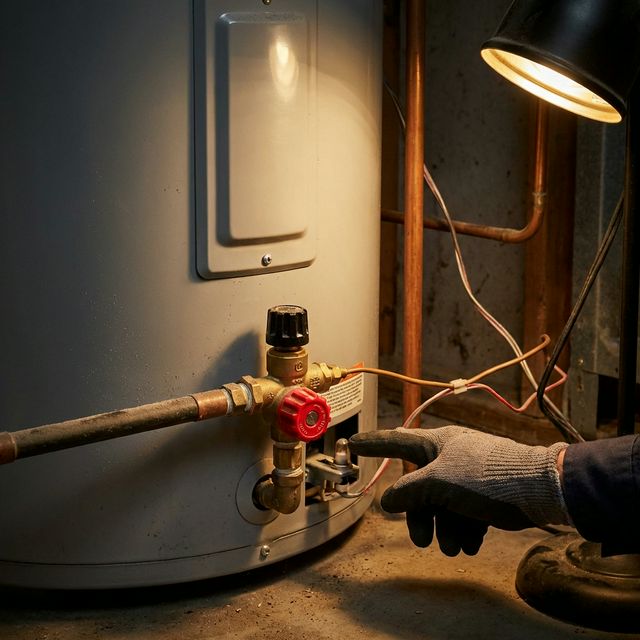
Safety Disclaimer
Water heater maintenance involves working with pressurized systems, scalding hot water, and potentially hazardous electrical or gas connections. Always shut off power (electric heaters) or gas supply (gas heaters) and allow water to cool to a safe temperature before beginning any maintenance. Wear appropriate safety equipment including gloves and eye protection. If you're uncomfortable with any step, contact a licensed plumber.
A gas water heater pilot light that won’t stay lit is one of the most common service calls I get. The homeowner wakes up to a cold shower, goes to the water heater, sees the pilot is out, relights it, and then it goes out again within a few hours or days.
The fix is usually cheap and fast. In about 80 percent of cases, the problem is a thermocouple that costs less than a burrito at Chipotle. The other 20 percent involves draft issues, a dirty pilot tube, or a failing gas valve. Let me walk through each one.
How the pilot light system works
Before you troubleshoot, it helps to understand what you’re looking at. A standard gas water heater has four components in the pilot assembly:
- Pilot tube — A thin copper or aluminum tube that delivers a small, constant flow of gas to the pilot burner.
- Pilot burner — The tiny nozzle where the pilot flame actually burns.
- Thermocouple — A metal probe that sits directly in the pilot flame. When heated, it generates a tiny electrical voltage (about 20-30 millivolts) that holds the gas valve open.
- Gas control valve — The main valve that controls gas flow to both the pilot and the main burner. The thermocouple signal tells it to stay open.
When you press and hold the gas knob to “Pilot,” you’re manually overriding the gas valve to allow gas to flow. Once the pilot is lit and has heated the thermocouple for 30 to 60 seconds, the thermocouple generates enough voltage to hold the valve open on its own. When you release the knob, the thermocouple takes over.
If the thermocouple is not generating enough voltage, releasing the knob cuts the gas and the pilot dies.
Cause 1: Bad thermocouple (most common)
The thermocouple is a wear part. It sits in an open flame 24/7, and over time the tip erodes, the internal wiring degrades, and it can no longer generate enough voltage to hold the gas valve open.
Symptoms:
- Pilot lights when you hold the knob down
- Pilot goes out within seconds of releasing the knob
- Pattern repeats every time you try
How to fix it:
- Turn the gas knob to “off” and wait 10 minutes for any residual gas to dissipate.
- Locate the thermocouple. It runs from the gas valve down to the pilot assembly. At the gas valve end, it connects with a brass nut.
- Disconnect the thermocouple at the gas valve using a 7/16” wrench (or an adjustable wrench). Turn counterclockwise.
- Remove the old thermocouple from the pilot bracket. It is usually held with a small clip.
- Install the new thermocouple. Slide the tip into the pilot bracket so it sits in the path of the pilot flame. The tip should be about 1/2 inch into the flame — not touching the pilot burner itself.
- Thread the nut back into the gas valve. Hand-tighten, then snug it with the wrench. Don’t overtighten. A quarter-turn past hand-tight is enough.
- Relight the pilot and test.
Universal thermocouples are available at hardware stores for about $8 to $15. They come in several lengths (24”, 30”, 36”). Measure your old one before you buy, or bring it to the store.
Cause 2: Thermocouple not positioned correctly
Sometimes the thermocouple is fine, but it has shifted out of position. If the tip is not sitting directly in the pilot flame, it won’t get hot enough to generate adequate voltage.
Symptoms:
- Pilot lights but goes out intermittently
- Works for a while after relighting, then fails again
- Thermocouple looks intact (no obvious corrosion or damage)
How to fix it:
Look at where the thermocouple tip sits relative to the pilot flame. The tip should be enveloped by the outer cone of the pilot flame. If it has shifted to the side or above the flame, gently bend the thermocouple rod to reposition the tip back into the flame path.
This is a free fix that takes two minutes. If the thermocouple keeps shifting, the retaining clip may be broken. Replacement clips come with most universal thermocouple kits.
Cause 3: Dirty or clogged pilot tube
The pilot tube delivers gas to the pilot burner. If it gets partially clogged with dust, spider webs, or combustion byproducts, the pilot flame becomes small and weak. A weak pilot can’t heat the thermocouple enough.
Symptoms:
- Pilot flame is small, yellow, or flickering
- Pilot flame blows sideways instead of burning straight up
- Flame is barely visible
How to fix it:
- Turn the gas off and let everything cool.
- Remove the pilot assembly (usually held by a single bracket or clip).
- Use compressed air to blow through the pilot tube from the burner end.
- Clean the pilot orifice with a needle or thin wire. The orifice is a tiny hole at the tip of the pilot burner. Don’t enlarge it — just clear any debris.
- Reassemble and relight.
While you are down there, check the main burner area for dust and debris. A clean combustion chamber promotes better airflow and more stable flame performance.
Cause 4: Draft problems
Gas water heaters need combustion air, and the exhaust gases need a clear path up through the flue. If drafts push air across the pilot flame, or if the vent pipe has a downdraft pulling air backward through the heater, the pilot blows out.
Symptoms:
- Pilot goes out on windy days
- Pilot goes out when a bathroom exhaust fan or kitchen range hood runs
- Pilot goes out when the furnace starts up (competing for combustion air in a tight space)
How to fix it:
- Check the vent cap on the roof. It should be in good condition with no damage or obstructions (bird nests are very common).
- Make sure the utility room has adequate combustion air. A louvered door or vents to adjacent spaces are usually sufficient. If the room is sealed tight, the water heater and other gas appliances compete for air.
- If competing exhaust fans are the problem, crack a window when running the range hood. Some homeowners install a dedicated combustion air intake, a duct from outside directly to the utility room.
Cause 5: Failing gas control valve
If you have replaced the thermocouple, confirmed its positioning, cleaned the pilot tube, and eliminated draft issues, the gas control valve itself may be failing. The internal electromagnet that the thermocouple signal holds open can weaken over time.
Symptoms:
- New thermocouple does not solve the problem
- Pilot lights perfectly but main burner does not ignite when the thermostat calls for heat
- Gas valve feels very hot to the touch (internal failure)
This is a professional repair. Gas control valves cost $100 to $250 and require matching the exact model to your water heater. Installation involves disconnecting the gas supply and thermocouple, and it is the one repair on this list that I recommend leaving to a licensed plumber, especially if you are not comfortable working with gas connections.
At this point, evaluate the age of the water heater. If it is more than 10 years old and needs a new gas valve, replacement of the entire unit may make more financial sense. More on that in our guide on how long water heaters last.
How to relight the pilot
Most gas water heaters have relighting instructions printed on a sticker on the front. The general steps are:
- Turn the gas knob to “Off.” Wait 5 to 10 minutes.
- Turn the gas knob to “Pilot.”
- Press and hold the knob down (this manually opens the gas valve).
- While holding the knob, press the piezo igniter button (the red or black button nearby). If your model doesn’t have an igniter, use a long barbecue lighter held near the pilot opening.
- Hold the knob down for 30 to 60 seconds after the pilot lights. This gives the thermocouple time to heat up.
- Release the knob slowly. The pilot should stay lit.
- Turn the knob from “Pilot” to “On.” The main burner should fire when the tank temperature is below the thermostat setting.
If the pilot doesn’t light at all (no flame, even while holding the knob), gas is not reaching the pilot. Check that the main gas supply valve on the pipe leading to the water heater is open (handle parallel to the pipe means open).
When to call a professional
Handle these situations by calling a licensed plumber or your gas company:
- You smell gas but the pilot is off and the gas knob is in the off position
- The gas valve is leaking at any connection point
- The main burner fires erratically — shooting flames outside the combustion chamber
- You are not comfortable working around gas connections
There is no shame in calling a pro. Gas isn’t something to experiment with. A bad thermocouple is a fine DIY job. A gas valve replacement or anything involving the gas supply line is worth the service call.
Related guides
- Gas vs. Electric Water Heater Maintenance — Full comparison of gas and electric maintenance needs
- Water Heater Safety: 7 Hazards Every Homeowner Should Know — Gas leak detection and CO safety
- How to Drain a Hot Water Heater — May need to drain before major gas repairs
- When to Replace Your Anode Rod — Another common gas heater maintenance item
Sources
- Honeywell Home — Gas Control Valve Troubleshooting — Thermocouple testing and replacement procedures
- A.O. Smith — Gas Water Heater Service Guide — Pilot assembly diagrams and part numbers
- National Fire Protection Association — Gas appliance safety standards