How to Test a Water Heater Element with a Multimeter
How to test electric water heater elements with a multimeter. Check for burnt-out or grounded elements before calling a plumber.
Safety Disclaimer
Water heater maintenance involves working with pressurized systems, scalding hot water, and potentially hazardous electrical or gas connections. Always shut off power (electric heaters) or gas supply (gas heaters) and allow water to cool to a safe temperature before beginning any maintenance. Wear appropriate safety equipment including gloves and eye protection. If you're uncomfortable with any step, contact a licensed plumber.
When an electric water heater stops producing hot water, the heating element is the most common culprit. Elements burn out, develop internal shorts, or get so coated in mineral scale that they can’t transfer heat effectively. The good news is that testing them takes about 15 minutes and requires nothing more than a basic multimeter.
I keep a multimeter in my truck and use it on almost every electric water heater service call. Half the time the homeowner is convinced they need a new water heater, and what they actually need is a $12 element. That’s a big difference.
How electric water heaters work
Most residential electric water heaters have two heating elements: an upper element and a lower element. They don’t run at the same time. The upper element heats the top of the tank first, then the upper thermostat switches off and the lower thermostat activates the lower element to heat the rest of the tank.
This sequential design is why element failure produces different symptoms depending on which one dies:
- Upper element fails: No hot water at all, because the upper thermostat never reaches its setpoint and never hands off to the lower element.
- Lower element fails: You get some hot water from the top of the tank, but it runs out fast because only the upper third of the tank gets heated.
If both elements are working but you are still running out of hot water, the problem is usually a thermostat setting or sediment buildup. Flushing the tank should be your first step in that case.
Tools you need
- Digital multimeter — Any basic model works. You need the ohms (Ω) setting, which measures resistance. A decent multimeter costs $15 to $30 at any hardware store.
- Flathead and Phillips screwdrivers — For the access panels.
- Non-contact voltage tester — To confirm the power is off. This is a $15 pen-shaped tool that beeps or lights up near live wires. Do not skip this.
Safety first
You are working with 240 volts. That can kill you.
- Go to your electrical panel and turn off the breaker labeled for the water heater. It is typically a 30-amp double-pole breaker.
- Verify at the heater. Remove the upper access panel (two screws on a metal plate on the side of the tank). Fold back the insulation. Hold your non-contact voltage tester near the wire connections to the thermostat. No beep, no light = safe to proceed.
- Do not rely on the breaker label alone. Panels get mislabeled. Always test.
Step-by-step: testing with a multimeter
Step 1: Access the elements
Each element has its own access panel on the front of the tank. Remove the screws, pull off the panel, and fold the insulation back. You will see the thermostat with wires running to two screws on the element below it.
Step 2: Disconnect the wires
Each element has two wires connected to two terminal screws. Use a screwdriver to loosen the screws and gently pull the wires off. This is necessary because testing an element while it is still connected to the thermostat circuit can give a false reading.
Take a photo before disconnecting so you remember which wire goes where. It matters less on elements (either terminal works), but it is a good habit.
Step 3: Test for continuity (is the element burnt out?)
Set your multimeter to the lowest ohms range (usually marked Ω or with a horseshoe symbol). Some digital meters have an auto-range function that handles this for you.
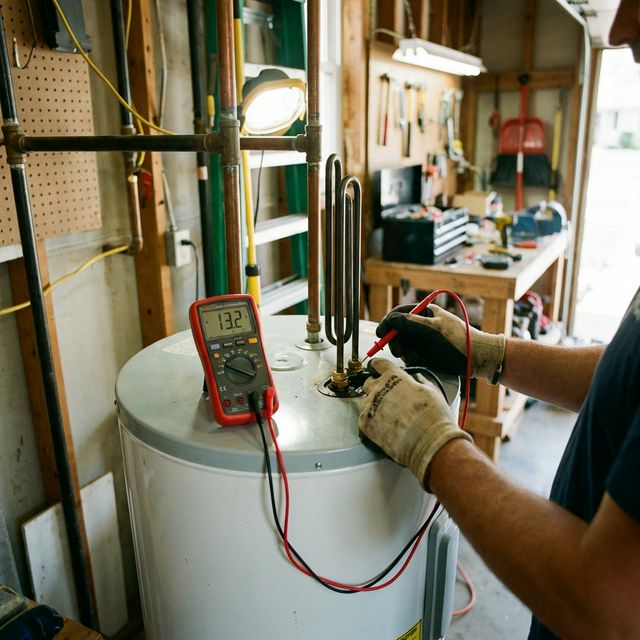
Touch one probe to each element terminal screw. You are measuring the resistance through the heating coil inside the element.
Reading the results:
| Multimeter reading | What it means |
|---|---|
| 10-16 ohms | Element is good (4500W element on 240V) |
| OL, infinity, or no reading | Element is open (burnt out). Needs replacing. |
| 0 ohms | Element has a dead short. Needs replacing. |
The expected resistance depends on the element wattage. For common residential elements:
- 4500W at 240V = about 12.8 ohms
- 3500W at 240V = about 16.5 ohms
- 5500W at 240V = about 10.5 ohms
The formula is R = V² / W, but you don’t really need to calculate it. If your meter shows a reading in the 10-20 ohm range, the element is probably fine. If it shows OL (open loop) or zero, it’s bad.
Step 4: Test for a grounded element
This is the test most people skip, and it catches a problem that the continuity test misses. A grounded element has a crack in its insulation that allows current to leak to the tank body. The element might still heat water, but it draws more power than it should, can trip the reset button repeatedly, and could create a shock hazard.
Keep your multimeter on the ohms setting. Touch one probe to either element terminal screw. Touch the other probe to the bare metal body of the element (the exposed metal flange or the tank itself near the element).
Reading the results:
| Multimeter reading | What it means |
|---|---|
| OL or infinity | No ground fault — element insulation is intact |
| Any numerical reading | Element is grounded. Needs replacing. |
If you get any reading at all, even a high one like 100,000 ohms, the element has a ground fault and should be replaced.
Step 5: Test the other element
Repeat Steps 2 through 4 on the other element. While you are in there, check both thermostats by pressing the red reset button on each one. If it clicks when you press it, the thermostat had tripped, which could indicate a problem with the element it controls.
Replacing a bad element
If your testing reveals a bad element, replacement is a DIY-friendly job. You will need to drain the water heater first, since the elements thread into the tank below the waterline.
What you need:
- Replacement element (match the wattage and type — screw-in or bolt-on)
- Element wrench (a large, specialized socket that fits the element hex)
- Teflon tape for the threads
- A bucket and towels
The whole job takes about an hour, including drain and refill time. Elements cost $8 to $20 depending on the type. Calling a plumber for this job typically runs $150 to $250 in labor, so it is worth doing yourself if you are comfortable with the process.
When the element is not the problem
If both elements test good, the problem is elsewhere:
-
Thermostat failure: Test the thermostats with your multimeter. Set the meter to continuity or ohms. With power off and wires disconnected, the thermostat should show continuity (near 0 ohms) between the input and element terminals when the dial is set above room temperature. If it shows OL, the thermostat is bad. Replacement thermostats cost $8 to $15.
-
Tripped high-limit reset: The red button on the upper thermostat is a safety cutoff. If it keeps tripping, either the thermostat is set too high, the element is grounded, or the thermostat itself is faulty.
-
Sediment insulating the lower element: Heavy sediment accumulation on the lower element reduces heat transfer and causes the lower thermostat to run continuously. Flushing the tank may solve this without any parts replacement.
-
Undersized tank: If the tank is simply too small for your household demand, no amount of element testing will fix the issue. A 40-gallon tank supports about two showers back-to-back. Three or four people showering in succession need a 50- or 80-gallon unit.
Related guides
- How to Drain a Hot Water Heater — Required before element replacement
- Gas vs. Electric Maintenance Differences — Full comparison of maintenance needs
- Water Heater Safety: 7 Hazards Every Homeowner Should Know — Electrical safety protocol
- When to Replace Your Anode Rod — Another common wear part
Sources
- Rheem — Electric Water Heater Troubleshooting — Manufacturer element testing guidelines
- A.O. Smith — Homeowner’s Guide to Electric Water Heater Maintenance — Element resistance specifications
- U.S. Department of Energy — Water Heating — Efficiency and maintenance recommendations