How Long Do Water Heaters Last? Lifespan by Type and Warning Signs
Water heaters last 8 to 12 years on average. Learn what affects lifespan, the warning signs of failure, and when to repair vs. replace.
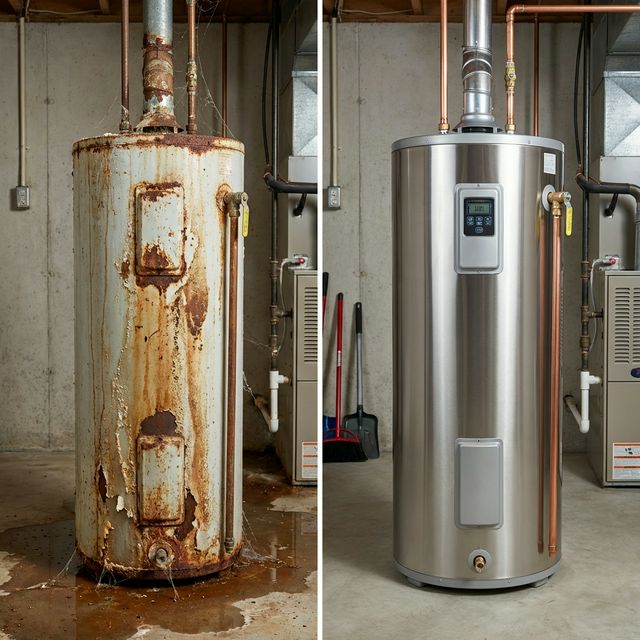
Every water heater has a serial number sticker on the side. Somewhere on that sticker is a date. Most people never look at it until the tank starts leaking on a Saturday morning and they are standing in a utility room with wet socks, wondering if this thing is 5 years old or 15.
Here is the short answer: a well-maintained tank water heater lasts 8 to 12 years. A neglected one lasts 6 to 8. A tankless unit can run 15 to 20 years. But those are averages, and your mileage depends on water quality, maintenance habits, and, honestly, a bit of luck.
Average lifespan by type
| Type | Average lifespan | Key factor |
|---|---|---|
| Gas tank | 8-12 years | Burner heat stress on tank bottom |
| Electric tank | 10-15 years | Element and thermostat wear |
| Tankless gas | 15-20 years | Heat exchanger scale buildup |
| Tankless electric | 15-20 years | Heating element lifespan |
| Heat pump (hybrid) | 12-15 years | Compressor and element life |
These ranges assume average water hardness (60-120 ppm) and reasonable maintenance. Either extreme, hard water with no maintenance or soft water with annual service, will shift these numbers significantly.
What actually kills a water heater
Water heaters don’t die of old age. They die from one (or more) of these four things:
1. Corrosion eats through the tank
The steel tank is lined with glass (vitreous enamel) to prevent rust. But that lining develops micro-cracks during thermal expansion cycles, exposing bare steel to water. The anode rod exists to sacrifice itself and protect those exposed spots. When the anode rod is fully consumed and not replaced, the exposed steel corrodes.
Once the tank itself starts rusting, there is no repair. Rust-colored water from the hot side only (not the cold) is the classic sign. By the time you see puddles forming at the base, the tank wall has thinned enough to leak and you are looking at replacement within days or weeks.
How to extend tank life: Replace the anode rod every 3 to 5 years. This single maintenance step can add 5 or more years to a water heater’s life, yet almost nobody does it.
2. Sediment overheats the tank bottom
Municipal water carries dissolved minerals, mainly calcium and magnesium. When water is heated, these minerals precipitate out and settle at the bottom of the tank. Over time, the sediment layer thickens.
On a gas water heater, this sediment sits between the burner flame and the water. The burner fires longer, the tank bottom gets hotter than designed, and the steel weakens. You will hear popping and rumbling sounds as steam bubbles escape through the sediment. Those sounds are damage in progress.
On an electric water heater, sediment buries the lower element. The element works harder, overheats, and eventually burns out. Element replacement fixes the symptom, but the sediment remains and will kill the next element, too.
How to prevent it: Flush the tank annually. In hard water areas (above 150 ppm), flush every 6 months. If you are not sure whether it is time, here are the signs your water heater needs flushing.
3. Thermal stress fatigues the tank
Every time the burner fires or the element runs, the tank metal expands. When the burner shuts off, the tank contracts. Over thousands of heating cycles, this expansion and contraction fatigues the metal and the glass lining. It is the same principle that causes a paper clip to break if you bend it back and forth enough times.
You can’t eliminate thermal cycling, but you can reduce how hard each cycle works. A well-insulated tank in a heated space has smaller temperature swings. A tank in a cold, unheated garage takes bigger hits. This is one reason why water heaters in garages tend to fail sooner than those in climate-controlled utility rooms.
Setting the temperature to 120°F instead of 140°F also reduces the severity of each expansion cycle.
4. Water chemistry accelerates everything
Water hardness gets the most attention, but pH matters too. Acidic water (pH below 7) is more corrosive and eats anode rods faster. Alkaline water (pH above 8.5) accelerates mineral scaling. If you are on well water, test it annually. Municipal water reports are available from your utility and tell you the hardness and pH of your supply.
Chloramines, used by many municipalities as a disinfectant, are also harder on anode rods than traditional chlorine. If your water system uses chloramines, consider a powered anode rod, which uses a small electrical current instead of sacrificial metal and lasts the life of the heater.
Warning signs your water heater is failing
Watch for these indicators, especially once the unit passes its eighth year:
Rust-colored hot water
Brown or reddish water from only the hot side (run both taps to compare) indicates internal tank corrosion. This is the most definitive sign that the tank is nearing the end. Replacing the anode rod at this point may slow the corrosion, but if the rod is already gone, the damage may be too advanced.
Rumbling or popping sounds
As described above, this is steam escaping through hardened sediment. Flushing the tank can help if the sediment hasn’t calcified into a solid layer. If flushing doesn’t clear the noise, the sediment has hardened and the tank is working overtime.
Moisture or pooling around the base
Small drips at the bottom of the tank usually mean the tank wall has thinned enough to seep. This is not a repair situation. It is a “replace before it floods” situation. If the water is coming from a fitting or the T&P valve discharge pipe instead, those are repairable. Check the source carefully.
Declining hot water capacity
If you used to get 20-minute showers and now run out at 10, either sediment is displacing water volume inside the tank, the lower element is failing (electric), or the dip tube has cracked and is mixing cold water into the hot. A failing dip tube is repairable. The others point to broader issues.
Frequent thermocouple or element replacements
If you are replacing the same part every year or two, the rest of the system is likely contributing to the failure. On gas units, a failing thermocouple every 12 months often means combustion byproducts are corroding it, which suggests a venting or combustion air problem. On electric units, elements burning out every 18 months usually means unchecked sediment.
Rising energy bills
A water heater that is losing efficiency due to sediment or failing components works harder and longer to maintain temperature. If your energy costs have crept up without an obvious explanation, the water heater is worth investigating, especially if it is past the 8-year mark.
Repair vs. replace: the decision framework
Not every problem requires a new water heater. Here is how I talk through the decision with homeowners:
| Repair | Situation | Typical cost |
|---|---|---|
| Yes | Bad thermocouple on a 5-year-old gas unit | $15-$20 part |
| Yes | Failed element on a 7-year-old electric unit | $12-$20 part |
| Yes | Anode rod replacement on any unit under 10 years | $20-$50 part |
| Maybe | Gas valve on a unit under 8 years | $150-$250 part + labor |
| No | Tank leak | No repair possible |
| No | Multiple failures on a 10+ year unit | Diminishing returns |
| No | Rust-colored water with a depleted anode | Tank is already corroding |
The general rule: if the repair costs more than half the price of a new water heater, and the unit is past the midpoint of its expected life, replacement usually makes more financial sense.
How to find your water heater’s age
If you do not know when your water heater was installed, the serial number holds the answer. Most manufacturers encode the manufacture date in the first few characters:
- A.O. Smith, Rheem, Bradford White: The first four digits are usually the year and month (e.g., “0815” = August 2015, or “1509” = September 2015 depending on the brand).
- Some brands use letter codes where A=January, B=February, and so on.
If the encoding is unclear, search the manufacturer’s website with your model and serial number. Most manufacturer support pages have serial number decoders, or you can call their support line for help.
Making your next water heater last longer
When you do replace the unit, here is how to maximize the investment:
- Flush annually from year one. Don’t wait until you hear rumbling.
- Check the anode rod at year 3, then every 2 years. Replace when it is 50 percent consumed.
- Set temperature to 120°F. Less thermal stress, lower energy costs, reduced sediment formation.
- Install a sediment trap on the gas supply line if the plumber doesn’t. It is code-required and prevents debris from clogging the gas valve.
- Consider a powered anode rod if you have aggressive water chemistry. It costs $100 to $200 but eliminates the need for periodic anode replacement.
- Keep clearance around the unit for service access and combustion air (gas models).
Related guides
- How to Drain a Hot Water Heater — Essential annual maintenance
- When to Replace Your Anode Rod — The maintenance step most people skip
- How to Flush a Water Heater — Complete flushing guide
- 5 Signs Your Water Heater Needs Flushing — Know when it is time
- Water Heater Temperature Settings — Optimal temperature for longevity
- Gas vs. Electric Maintenance — Fuel-specific care tips
Sources
- U.S. Department of Energy — When to Replace Your Water Heater — Lifespan guidelines and efficiency standards
- International Association of Certified Home Inspectors — Water heater inspection and age-determination methods
- Consumer Reports — Water Heater Buying Guide — Reliability data and brand comparisons